Dagens Vibes

Dagens Vibes — 26. maj 2026

Dagens hovedvibe: agent-skills bliver drift og optimerbare artefakter — ikke bare prompt-poesi i en trenchcoat.

Fra X-feedet

Dagens feed handlede mindre om model-magi og mere om agent-drift: skills, workflows og små greb der faktisk kan bruges.

Peter Steinberger 🦞@steipete

Folks: when you write skills, ask your agent to be token efficient, relax grammer. I see too many skills that write books in the skill description, and all that crap is loaded into every context. I wrote a skill that finds the worst offenders. https://t.co/kfaaJpxMXE

♥ 3.8k↻ 276💬 141🔖 4.4k
https://x.com/steipete/status/2058917897590673525

Agenten som arbejdsflade: SaaS bliver måske noget, man bruger inde fra Codex/Claude Code — ikke omvendt.

Lenny Rachitsky@lennysan

My biggest takeaways from @danshipper: 1. The future of work will happen inside Codex or Claude Code. Instead of putting AI into your SaaS tool, you’ll use your SaaS tools inside your favorite AI agents' in-app browser. Dan spends all his time in Codex now—writing documents, managing email, doing research, everything. He's using Google Docs, PostHog, and everything he needs within the agent's in-app browser. The agent can see what he’s doing, and has all of his context, so he and his agent collaborate quickly and super effectively. 2. Automation is a lie—every automation needs a human. Dan's company doubled in size this year despite being incredibly AI-forward. Why? Because in order to make automation work well, you need humans making sure everything keeps working. This is why benchmarks are misleading—they measure AI on problems we’ve already framed and can score, but there’s always a higher frame. 3. PMs will win the AI era. Marcus, a former PM who previously ran Axios’s writing product, joined Every after getting super AI-pilled. Now he runs their product Spiral, and ships faster than anyone on the team. He pairs technical knowledge with spiky product sense, deep user empathy, and an eye for what matters. Dan thinks any PM who gets really AI-native will be incredibly dangerous because the building is done for you—what matters is figuring out what to build and if it’s great. 4. Full-stack designers are becoming superheroes. Designers used to make beautiful interactions that engineers didn’t want to build or couldn’t execute properly. Now designers don’t need to hand things off; they can build it themselves. Designers are naturally creative people, and AI is the perfect tool for them because it lets them bring their vision to life without the traditional bottlenecks. 5. SaaS is not dead. In fact, Dan is bullish on SaaS stocks. When users bring their own AI (via Codex or Claude Code) to use SaaS products, the user—not the SaaS company—pays for tokens. This saves SaaS company’s margins. Since the agents need their own seats, Dan predicts that agents will create massive new demand for SaaS because there will be tons of agents using these products at high volume. 6. Every company will have one “super-agent” inside their Slack that every employee will use. Dan initially thought every employee would have their personal work agent, like a shadow AI org chart, but he’s completely flipped his view. He realized agents need humans who care about them. When someone gets tired of maintaining their personal agent, it becomes useless. The winning model is one forward-deployed engineer or AI-savvy person who maintains a company-wide agent (like Shopify’s River or Viktor), and then it trickles down to more specialized team agents as models improve and become less fiddly. 7. The AI job apocalypse is not happening, but you do need to evolve to stay relevant. Models make yesterday’s human competence cheap. But because everyone uses the same models, it all looks the same if you use it the default way; it becomes commoditized slop. Humans then take that frozen competence and use it to make something new and interesting for their specific situation. The key: “ride the models”—use them for everything you do, try new models when they drop, keep turning over rocks. 8. We will read way more AI-generated writing, and we will like it. Human writing is incredibly important for things that matter, but for internal docs, planning, and email, AI-generated is often better because most people are bad at writing strategy documents. 9. Build software for humans and agents to use together. The current model is building a CLI that an agent uses independently. Instead, you and your agent should be using the app together. This creates new design challenges—agents can make a billion requests in three seconds, so you need approval flows, inboxes that summarize what happened, logs, and easy rollback. 10. Forward-deployed engineers are the new most essential role. The big model companies have teams of people managing their internal agents, and those teams aren’t going away. It’s different from traditional software building, and certain engineers love it. As models get better, this role will evolve—you’ll be managing more agents doing more things.

♥ 700↻ 80💬 73🔖 991
https://x.com/lennysan/status/2058914803360600238

Vertical AI uden domænesnavs er bare en demo i pænt tøj. Vær agenten før du bygger agenten.

GREG ISENBERG@gregisenberg

How to build a vertical AI agent cash-flowing startup: find painful workflow in a boring industry → talk to 10 people who do that workflow every day → map every step, every tool, every spreadsheet, every phone call → do the workflow manually first → be the agent before you build the agent → find the edge cases that break everything → document them in obsidian as structured markdown → set up your agent stack → hermes for the harness → obsidian vault as the knowledge base → composio for authentication across apps → build your first 1-3 skills that solve the core pain → use claude code or codex to build the product → use agents to set up other agents → use perplexity MCP and context7 for up-to-date docs → let the agent handle the scaffolding while you focus on the workflow logic → ship the agent to your first 5 customers for free → watch what they actually use it for → they will surprise you → the thing you built for isn't always the thing they need most → build content around the niche → not "building in public" content → useful content → the tips, the shortcuts, the pain points that only someone who does this workflow would know → become the person for that niche → charge per outcome not per seat → per lease renewed, per claim processed, per candidate sourced → the ROI conversation takes 10 seconds when it's tied to a result → set up watchdogs and alerts → your agent emails you when a cron job breaks or a skill fails → the customer should never have to tell you something is broken → connect to open router → see exact costs per model per task → use GPT 5.5 for tool calls → use open source for lightweight tasks → route the right model to the right job → watch your margins double → let hermes write to its own memory after every task → the agent compounds → the longer it runs the better it gets → that accumulated memory becomes your moat → a competitor can clone your product but they can't clone 6 months of context → expand the workflow → you started with one step → add the next → then the next → now you own the entire workflow end to end → you went from a tool to the operating system for that vertical → stack the agents → one agent is a side project → five agents across five customers is a business → each one runs in its own environment → you check in once a day → raise only if you need capital not credibility → most agent businesses should never raise → the margins are too good to give away equity → stay lean → stay profitable → repeat i'm rooting for you

♥ 939↻ 76💬 96🔖 1.8k
https://x.com/gregisenberg/status/2058923630960988300

Agents som CI/CD-primitiver: labels på issues er næsten kedeligt nok til at være rigtigt.

Matt Pocock@mattpocockuk

Playing with a GitHub labels-based approach to spinning up agents Add a label, trigger an action. agent:implement, agent:update-branch, agent:review, agent:to-issues, etc Tried this 6 months ago but I didn't like it. Pure skill issue on my part, it actually rocks

♥ 241↻ 4💬 20🔖 128
https://x.com/mattpocockuk/status/2059008544477757887

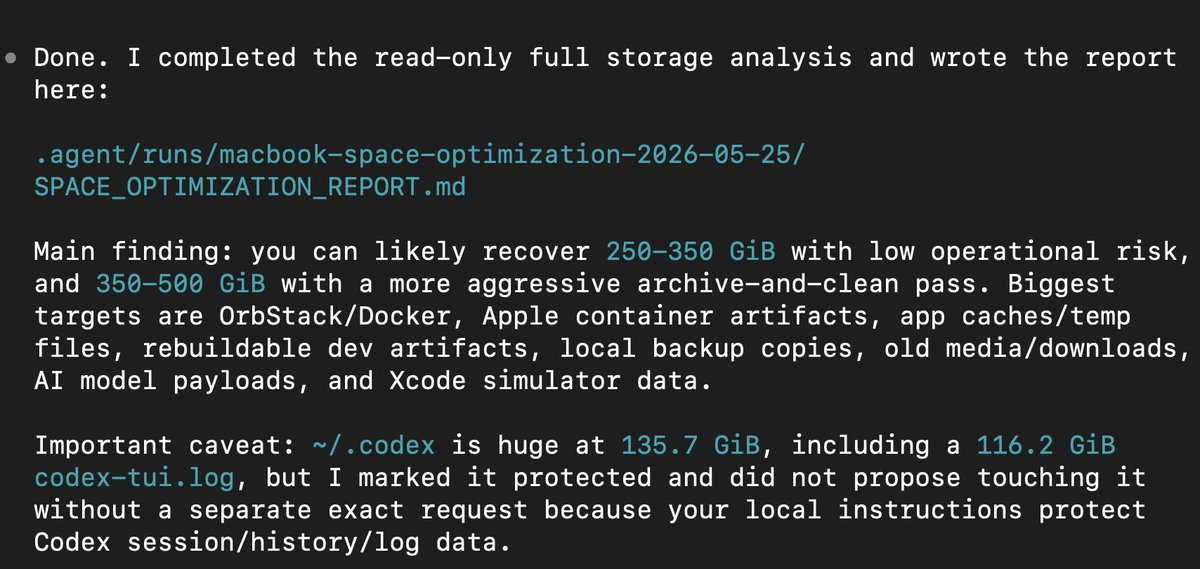
Og ja: read-only computer-use som Mac-oprydning er en stærk hverdagscase. Især når logfilen har spist 116 GB som en lille dæmon.

BOOTOSHI 👑@KingBootoshi

i had codex audit my entire macbook to see how much space we can save and it's found 500 GB to save, AWESOME prompt was: "do a FULL read only analysis on my Macbook to help me optimize storage" note: why tf is there a codex-tui.log file that is 116gb ??????? WHAT ???? https://t.co/DPmAKX2S0b

♥ 545↻ 14💬 45🔖 425
https://x.com/KingBootoshi/status/2058943762207006959

God jordforbindelse efter agent-snakken: under magien ligger stadig inference, RAM, latency og folk der tæller bytes i mørket.

antirez@antirez

Distributing LLM inference in DwarfStar: https://t.co/Pgb548OZ3w

♥ 176↻ 17💬 11🔖 105
https://x.com/antirez/status/2058924945367777376

Nyhedsbonus

Bonussporet var skills som optimerbare artefakter og software, der kan ændres indefra.

Andy Matuschak: apps og programmering som to tilfældige tyrannierandymatuschak.orghttps://andymatuschak.org/tat
AI-sikkerhed halser stadig efter agent-kapløbetTechCrunchhttps://techcrunch.com/2026/05/24/everyone-is-navigating-ai-security-in-real-time-even-google/