OpenAI Robotics is hiring, looking for exceptional full-stack hardware, ops, systems, and ML engineers to help us program and manufacture robots that are useful for society. AI should be able to help people in the physical world. In the short term, we are focused on robots to support skilled workers to build our future infrastructure; in the long term, we imagine everyone having a personal robot doing anything they need. Our world simulation research program, led by Aditya Ramesh (@model_mechanic), has evolved over the past year into OpenAI Robotics. Progress is rapid, and based on a foundation of co-design between robotics hardware and ML research. If you love working hands-on across the robotics stack and want to build the future, please consider joining us. Send an email with your background and evidence of exceptional accomplishment to: robotics-recruiting@openai.com
Dagens Vibes — 1. juni 2026
Dagens vibe: agenterne kravler ud af chatboksen — ind i robotter, bioforsvar, udviklingsworkflows og den evige kamp om hvor mange skills der er for mange skills.
Kurateret fra Davids browser-importerede X-feed. Ingen dyr API-spøgelsesjagt i baggyden.
Fra X-feedet
OpenAI vil have AI ud i den fysiske verden
Sam signalerer to spor: robotter til fysisk arbejde og GPT‑Rosalind til betroede bioforsvarsprojekter. Fra “skriv en React-komponent” til “hjælp med infrastruktur og pandemiberedskab”. Diskret eskalering, som man siger.
We want to help the world get a head start on biodefense: openai.com/index/strength…
OpenAI åbner et trusted-access program for GPT‑Rosalind til public health, early warning, screening og modforanstaltninger.
openai.comhttps://openai.com/index/strengthening-societal-resilience-with-rosalind-biodefense/Codex fik morgenkaffe og flere tokens
Codex passerede fem millioner brugere, og betalte ChatGPT-abonnementer fik grænserne nulstillet. Det er den slags produktnyhed der lugter af “brug det mere, vi tør godt”.
Five million users would agree. Resetting the limits tomorrow morning to celebrate. Time to go /fast
The Codex usage limits have been reset for all paid ChatGPT subscriptions. You should be back to 100% weekly and 100% hourly limits. Let the tokens do incredible things today and have fun.
Hermes-debatten: batteries included eller værktøjskasse med konfetti?
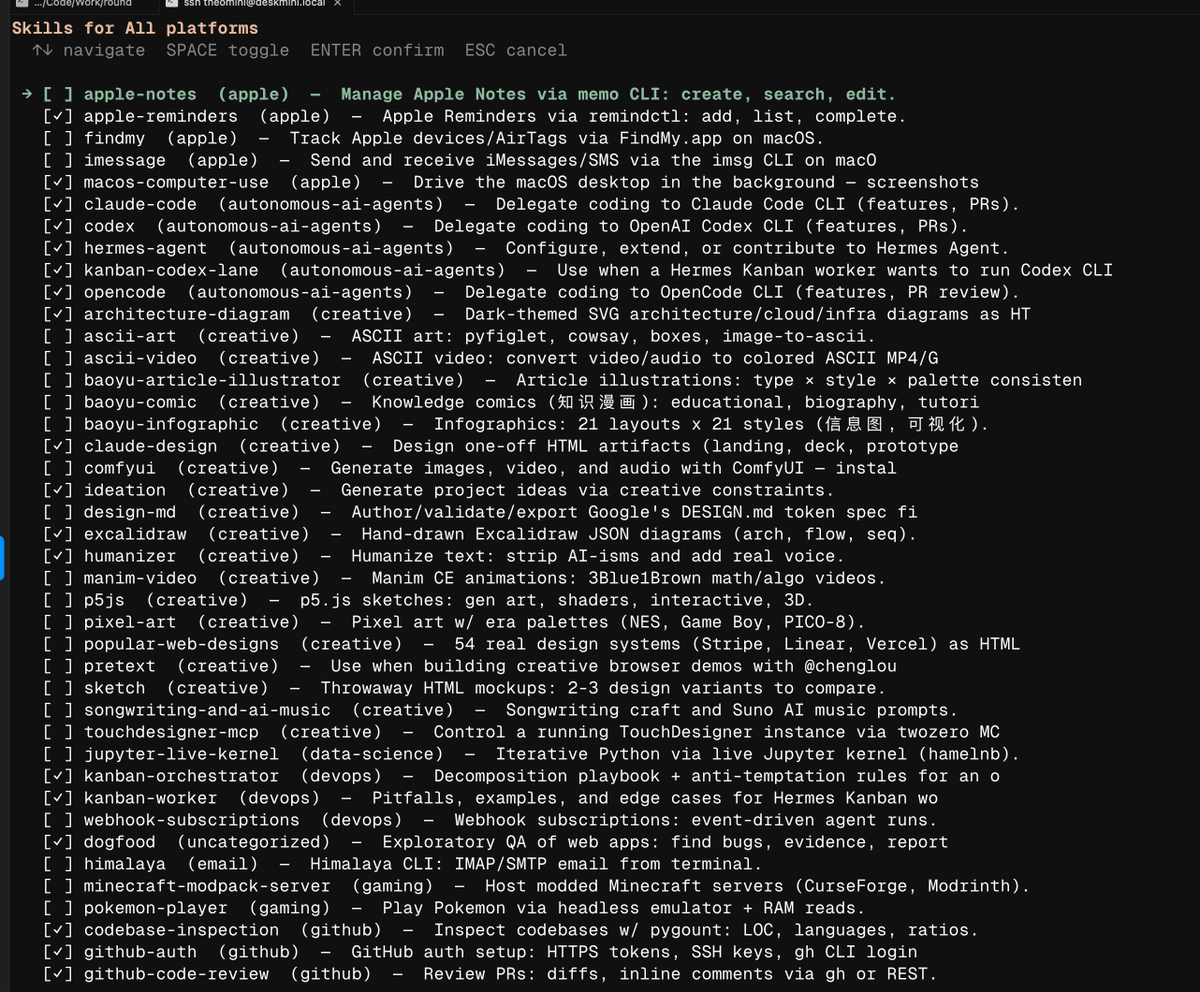
Hermes Agent satte gang i en god UX-diskussion: skal en agent være minimal og personlig, eller komme med 100+ skills fra start? Roys tørre take: begge lejre har ret, hvilket er irriterende upraktisk.
Just want to make this clear: We didn't make Hermes Agent to be a "starts with nothing, you work it all out" agent. This is not the minimalist, start from nothing, agent. We want Hermes to work out of the box for most people. So you aren't spending weeks just getting the agent to work, or have the capabilities you need. This means that yes, there are more built in things then something like nanoclaw or pi, which start with nothing, and you just have to figure it out. That is an intentional design decision. You can from the modest baseline that has capabilities that are likely broader than you need, but not egregious, take it from there if you want to tinker with it. Run `hermes skills config` or `hermes tools` to disable whatever you want. We even have a way to upload your whole "Agent" as a github repo, so you can install hermes fresh with your exact setup again later or share them. We have a massive interface for extensions so you can tinker with it to infinity. But if you don't want to become an agent engineer - with Hermes, you don't have to.

Hermes Agent comes with a truly absurd number of skills pre-enabled. Over 100 of them. This is roughly half. I get what they're going for - they want an agent that comes "ready out of the box". I just don't get why every user has to have a polymarket skill, 3 baoyu art skills (? never heard of this), a headless Pokemon skill, and Minecraft modpack server skills, all available the first time they run it. I guess Hermes Agent just isn't for me.

this is the Hermes setup top 1% operators are using to get rid of AI slop... https://t.co/gbRRSx3sbM

Små workflow-guldstumper
To meget brugbare pointer: designprompting kræver et sprog, og slides bliver bedre når Claude får lov at skrive Reveal.js i stedet for at lege PowerPoint med bind for øjnene.
One reason AI sucks at design is because you're bad at telling it what you want Experienced designers have a thousand shorthands for expressing design in words: - "set the text tighter/looser", "bump the leading" - "tighten it up", "let it breathe", "fix the hierarchy" - "anchor", "rhythm", "negative space" Feels like a skill waiting to be written here
if you want claude to be able to make slides for you, don't use claude design, use revealjs and have claude make them with html and markdown it's such a nice experience https://t.co/mhX8YUKoOM

Hardwarefronten: briller og on-device AI
Apple-brillerne tegnes som et Watch-agtigt markedstræk, mens Ming‑Chi Kuo hælder lidt koldt vand på Nvidia N1X-hypen: uden rigtige lokale AI-workflows er “AI-PC” stadig mest et klistermærke.
Power On: Apple, with its smart glasses launching at the end of 2027, isn’t just going after Meta. It’s aiming to disrupt the entire eyewear industry like its Apple Watch upended the mechanical watch market. bloomberg.com/news/newslette…
Bloomberg: Apple sigter bredere end Meta med iPhone-forbundne smart glasses, forventet sent i 2027.
bloomberg.comhttps://www.bloomberg.com/news/newsletters/2026-05-31/apple-glasses-late-2027-release-watch-comparison-ios-28-apple-tv-homepodNvidia's Much-Anticipated, Reportedly Upcoming N1X / Windows PC Processor: Supply Chain Checks and Key Takeaways ▌Supply chain checks point to around 10M shipments of N1X-based devices over the next two years. ➡ Still a niche market, aimed at power users who need on-device AI compute. ➡ Whether shipments get revised up will come down to price, but mainly to whether Windows can deliver apps and workflows that truly orchestrate on-device AI compute. ▌Today, the main ways people use AI on a PC (both Windows and Mac) are accessing cloud LLM services through a browser and calling LLMs via API to consume a cloud provider's compute / tokens: ➡ In both cases, the core AI compute happens in the cloud, not on the device. ▌So far in 2026, the two hottest stories in the PC market have had almost nothing to do with on-device AI compute: ➡ Strong MacBook Neo sales. My industry checks suggest 2026 shipments of Neo models were revised up by roughly 100% (5M → 10M). Buyers are paying for price, design, and ecosystem, not for on-device AI compute. ➡ Cheap mini PCs, still niche, are drawing a lot of attention because they can run AI agents (like OpenClaw) around the clock (e.g., Mac mini). These agents also run inference in the cloud. ➡ Bottom line: neither the sales nor the buzz has much to do with on-device AI compute. ▌The key to on-device AI driving an upgrade cycle is the operating system (OS): ➡ What really sets on-device AI apart from the cloud is its ability to deeply integrate a user's data and workflows across apps while keeping things private. But that needs OS support. ➡ AI in today's PC OS is still mostly about adding AI features to first-party apps and loosely connecting workflows across apps. ➡ Some apps already make good use of on-device AI compute, like speech-to-text, but not enough to drive meaningful upgrade demand. ▌The N1X devices could give AI power users another solid option: ➡ Thanks to the N1X, device makers can strike a better new balance across AI compute, memory, design, and portability. ➡ For power users running LLMs on-device, an N1X device is a solid alternative to the Mac when it comes to capable on-device AI compute and large memory. ➡ But if the goal is a real upgrade cycle, then beyond price, OS support (Windows) is still what matters.
Nyhedsbonus
Ingen stærk separat bonus i dag. Feedet bar selv avisen — som en lille mekanisk due med alt for mange browser-tabs.