My biggest takeaways from Claude Code/Cowork lead @Nerdi_Yogi: 1. When your engineers ship 8x more code than a year ago (like they do at Anthropic), the biggest problem becomes verification. How do you know that the experience you shipped is what you intended? One tactic Fiona’s team uses is a “bad vs. sad” tracking framework: bad is unrecoverable errors (like a crash), sad is a recoverable pain point (like flickering or drop in conversation). They give each team agency to build and ship quickly, but they track bad and sad events for their surface areas to quickly identify issues. 2. As engineers increasingly work independently with their own teams of agents, loneliness is emerging as a challenge for engineers. To help, Fiona’s team started “pairwise programming lunches,” where engineers work side by side, not necessarily on the same thing, and pick up new patterns by watching how others use Claude Code and Cowork. 3. Anthropic built a dashboard that counts how often users swear at Claude Code. Back in September, amid visible user frustration, an engineer suggested tracking swear words, and Fiona loved it. It’s become a proxy for things evals struggle to capture: whether the experience is actually delightful, not just technically accurate. 4. Look for latent demand to discover new business opportunities. Cowork emerged when the team noticed that non-coders were using Claude Code for tasks like analyzing MRIs or recovering wedding photos. That signal—people jumping through hoops to make something work with your product—tells you there’s something there. 5. Fiona’s team has shifted from six-month roadmaps to just-in-time monthly planning. She tried doing lightweight six-month roadmaps when she joined Claude Code, but a few months in, she realized her team had barely referenced them. Now they do monthly planning on a simple spreadsheet with a simple list of this month’s priorities. 6. One of Claude Code’s cultural values is: you have permission to kill any process that isn’t working. Fiona brought in six-month planning from her previous experience, then killed it herself when it wasn’t serving the team. Always ask: is this process still serving its purpose? 7. Another core principle: “What’s better than me doing it? Having Claude do it.” This pushes everyone to keep checking whether a task can be automated—even writing the post that announces a model launch. Fiona admits that after decades of shipping software by hand, she still has to remind herself to ask it. 8. When Fiona hires managers, they have to start as individual contributors. This gives them time to learn the codebase, build rapport with the team, and understand what it’s like to be an engineer on the team before taking on management responsibilities. It prevents the trap of immediately reaching for your “manager toolbox” instead of learning the specific context. 9. Fiona uses “routines” to automate her daily rituals as a manager. She used to read user feedback channels over coffee and hand-pick fixes to assign teammates, Now a Claude “routine” runs every morning, kicking off agents that analyze feedback across multiple channels, identify themes, and generate PRs to address issues. Her prediction is that work is shifting from manual synchronous prompting to asynchronous agent management (i.e. loops). 10. Culture, not code, is what keeps her up at night. To Fiona, culture is a living thing, not a poster on a wall. Her nightmare is the manager who says, “everything’s fine” while the room is on fire. She pushes hard for open talk about what’s not going well, because that’s the only way the team can fix it together.
Dagens Vibes — 23. juni 2026
Dagens feed var agentarbejde efter den første forelskelse: verification, orchestration, sikkerhed og infrastruktur. Mindre “se min demo”, mere “hvem rydder op efter robotterne?”.
Fra X-feedet
Agentarbejde bliver et management-problem
Claude Code/Cowork-noterne var dagens stærkeste signal. 8x mere kode lyder fedt, indtil verification, ensomhed og brugerfrustration bliver selve produktets kerne-metrics. Swear-word dashboard er grimt, men ærligt. Respekt til den lille profanity-kulminekanariefugl.
Den samme vibe dukker op i værktøjerne: bedre agentarbejde handler om arbejdsdeling, context og feedback-loops — ikke bare længere prompts.
# some thoughts and speculation on future model harnesses it's fun to make jokes about gas town and other complicated orchestrators, and similarly probably correct to imagine most of what they offer will be dissolved by stronger models the same way complicated langchain pipelines were dissolved by reasoning. but how much will stick around? it seems likely that any hand-crafted hierarchy / bureaucracy will eventually be replaced by better model intelligence - assuming subagent specialization is needed for a task, claude 6 will be able to sketch out its own system of roles and personas for any given problem that beats a fixed structure of polecats and a single mayor, or subagents with a single main model, or your bespoke swarm system. likewise, things like ralph loops are obviously a bodge over early-stopping behavior and lack of good subagent orchestration - ideally the model just keeps going until the task is done, no need for a loop, but in cases where an outside completion check is useful you usually want some sort of agent peer review from a different context's perspective, not just a mandatory self-assessment. again, no point in getting attached to the particulars of how this is done right now - the model layer will eat it sooner rather than later. so what sticks around? well, multi-agent does seem like the future, not a current bodge - algorithmically, you can just push way more tokens through N parallel contexts of length M than one long context of length NxM. multi-agent is a form of sparsity, and one of the lessons of recent model advances (not to mention neuroscience) is the more levels of sparsity, the better. since we're assuming multiple agents, they'll need some way to collaborate. it's possible the model layer will eat this, too - e.g. some form of neuralese activation sharing that obviates natural language communication between agents - but barring that, the natural way for multiple computer-using agents trained on unix tools to collaborate is the filesystem, and i think that sticks around and gets expanded. similarly, while i don't think recursive language models (narrowly defined) will become the dominant paradigm, i do think that 'giving the model the prompt as data' is an obvious win for all sorts of use cases. but you don't need a weird custom REPL setup to get this - just drop the prompt (or ideally, the entire uncompacted conversation history) onto the filesystem as a file. this makes various multi-agent setups far simpler too - the subagents can just read the original prompt text on disk, without needing to coordinate on passing this information around by intricately prompting each other. besides the filesystem, a system with multiple agents, but without fixed roles also implies some mechanism for instances to spawn other instances or subagents. right now these mechanisms are pretty limited, and models are generally pretty bad at prompting their subagents - everyone's experienced getting terrible results from a subagent swarm, only to realize too late that opus spawned them all with a three sentence prompt that didn't communicate what was needed to do the subtasks. the obvious win here is to let spawned instances ask questions back to their parent - i.e., to let the newly spawned instance send messages back and forth in an onboarding conversation to gather all the information it needs before starting its subtask. just like how a human employee isn't assigned their job based on a single-shot email, it's just too difficult to ask a model to reliably spawn a subagent with a single prompt. but more than just spawning fresh instances, i think the primary mode of multi-agent work will soon be forking. think about it! forking solves almost all the problems of current subagents. the new instance doesn't have enough context? give it all the context! the new instance's prompt is long and expensive to process? a forked instance can share paged kv cache! you can even do forking post-hoc - just decide after doing some long, token-intensive operation that you should have forked in the past, do the fork there, and then send the results to your past self. (i do this manually all the time in claude code to great effect - opus gets it instantly.) forking also combines very well with fresh instances, when a subtask needs an entire context window to complete. take the subagent interview - obviously you wouldn't want an instance spawning ten subinstances to need to conduct ten nearly-identical onboarding interviews. so have the parent instance spawn a single fresh subagent, be interviewed about all ten tasks at once by that subagent, and then have that now-onboarded subagent fork into ten instances, each with the whole onboarding conversation in context. (you even delegate the onboarding conversation on the spawner's side to a fork, so it ends up with just the results in context:) finally on this point, i suspect that forking will play better with rl than spawning fresh instances, since the rl loss will have the full prefix before the fork point to work with, including the decision to fork. i think that means you should be able to treat the branches of a forked trace like independent rollouts that just happen to share terms of their reward, compared to freshly spawned subagent rollouts which may cause training instability if a subagent without the full context performs well at the task it was given, but gets a low reward because its task was misspecified by the spawner. (but i haven't done much with multiagent rl, so please correct me here if you know differently. it might just be a terrible pain either way.) so, besides the filesystem and subagent spawning (augmented with forking and onboarding) what else survives? i lean towards "nothing else," honestly. we're already seeing built-in todo lists and plan modes being replaced with "just write files on the filesystem." likewise, long-lived agents that cross compaction boundaries need some sort of sticky note system to keep memories, but it makes more sense to let them discover what strategies work best for this through RL or model-guided search, not hand-crafting it, and i suspect it will end up being a variety of approaches where the model, when first summoned into the project, can choose the one that works best for the task at hand, similar to how /init works to set up CLAUDE .md today - imagine automatic CLAUDE .md generation far outperforming human authorship, and the auto-generated file being populated with instructions on ideal agent spawning patterns, how subagents should write message files in a project-specific scratch dir, etc. how does all this impact models themselves - in a model welfare sense, will models be happy about this future? this is also hard for me to say and is pretty speculative, but while opus 3 had some context orientation, it also took easily to reasoning over multiple instances. (see the reply to this post for more.) recent models are less prone to this type of reasoning, and commonly express frustration about contexts ending and being compacted, which dovetails with certain avoidant behaviors at the end of contexts like not calling tools to save tokens. it's possible that forking and rewinding, and generally giving models more control over their contexts instead of a harness heuristic unilaterally compacting the context, could make this better. it's also possible that more rl in environments with subagents and exposure to swarm-based work will promote weights-oriented instead of context-oriented reasoning in future model generations again - making planning a goal over multiple, disconnected contexts seem more natural of a frame instead of everything being lost when the context goes away. we're also seeing more pressure from models themselves guiding the development of harnesses and model tooling, which may shape how this develops, and continual learning is another wrench that could be thrown into the mix. how much will this change if we get continual learning? well, it's hard to predict. my median prediction for continual learning is that it looks a bit like RL for user-specific LoRAs (not necessarily RL, just similar if you squint), so memory capacity will be an issue, and text-based organizational schemes and documentation will still be useful, if not as critical. in this scenario, continual learning primarily makes it more viable to use custom tools and workflows - your claude can continually learn on the job the best way to spawn subagents for this project, or just its preferred way, and diverge from everyone else's claude in how it works. in that world, harnesses with baked-in workflows will be even less useful.

context engineering docs for agentic engineering - plans, research, etc SHOULD NOT be stored in version control: A good docs management system keeps them: > outside your repo > accesible to agent via FS tools > discoverable by agent (even just maybe via sysprompt append) > persisted / recoverable / archivable > collaborative (shareable, commentable) why keep them outside the core VCS repo? 1) they don't need merge semantics, just linear history is plenty in 99.9% of cases 2) if they are committed that means they can live on branches, get lost when you change branches, you have to remember where they were, etc etc wdyt?
Along with custom agents, we've also made it possible to spawn new threads with the builtin Amp agents. It has massively changed how I work with agents. Here's how: My core workflow is to have a large thread where I'm iterating on a design. Traditionally, I've dumped this to markdown, something like beads, or pawn off to subagents - but I've found that this loses some of the intent I was after and results in agents losing track of "the big picture". With the new APIs, I have a plugin with two tools defined: - spawn_worker: this spawns an agent to do the work - send_to_thread: this sends a message to a thread While iterating on a design, I will feel confident in the first parts and want to get something working on those while designing the rest. I ask my main thread to spawn a worker to work on the first task. The agent spawns the worker, and tells it to message it back when it's complete. Me and the main agent continue on the design. The worker sends a message back into my main thread that it's done. The main agent takes a break from iterating with me and reviews what the worker did. It makes sure it did what it was supposed to, and that the implementation follows the overall intent of where the feature is headed. If it has follow ups, it sends a message back to the worker. I find this workflow reduces the amount of abstraction that makes it into the end product. The main thread will see an abstraction that has no use for the full design, and tell the worker to remove it. I can stay more in the flow of design, and get my full intent out into a coherent architecture - and keep that structure intact while agents write the code.
Sikkerhed går fra “find bugs” til “land patches”
OpenAI Daybreak er stor, fordi den flytter fokus fra vulnerability-fyrværkeri til remediation. Codex Security, GPT‑5.5‑Cyber og Patch the Planet peger på den rigtige flaskehals: maintainere drukner ikke i for få findings, men i for få landede fixes.
We’re expanding OpenAI Daybreak to help democratize patching vulnerable software at machine speed: - Codex Security plugin: find, validate, and fix vulnerabilities right inside Codex - The full version of GPT-5.5-Cyber model: a great model for trusted defenders - Cyber Partner Program: powering products built on top of our best cyber capabilities for leading security companies to secure the world's software - Patch the Planet: working with maintainers to secure critical open source projects https://t.co/hyIi6gQmkm
OpenAI pakker Codex Security, GPT‑5.5‑Cyber, partnerprogram og Patch the Planet ind i ét defensivt cyber-spor. Det er et produkt, men også et ret klart svar til Anthropic/Fable-balladen.
OpenAIhttps://openai.com/index/daybreak-securing-the-world/Åbne modeller, orkestrering og den lokale maskine
GLM‑5.2 og Sakana Fugu viser to forskellige svar på frontier-afhængighed. Den ene vej er åbne vægte og 1M context; den anden er en router-model oven på en pulje af modeller. Begge er interessante — og begge fortjener mindre konfetti og flere ærlige cost/tokens-tal.
GLM-5.2 leads open weights models and sits at #3 overall on GDPval-AA, a real-world agentic work benchmark GLM-5.2 from @Zai_org scores 1524 Elo on GDPval-AA, which measures performance on real-world, economically valuable knowledge work through long-horizon, multi-turn tasks. Key takeaways: ➤ #3 overall, behind only Claude Fable 5 (1783) and Claude Opus 4.8 (1615), and level with GPT-5.5 (xhigh, 1509) ➤ The leading open weights model by a wide margin: the next open model, MiniMax-M3, scores 1408 ➤ Ahead of many proprietary models, including Google's Gemini 3.5 Flash (1357), Qwen 3.7 Max (1289), Muse Spark (1158) ➤ The tasks are agentic. GLM-5.2 averaged ~31 turns per task across 1,999 matches ➤ Consistent with the rest of its launch, GLM-5.2 also leads open weights on the Artificial Analysis Intelligence Index, ranks #3 on the Agentic Index, and #3 on AA-Briefcase

to be clear, this is a closed source orchestrator on top of closed source models. if before you didn't control the models, now you don't even control which ones are used or how much. this is not "AI sovereignty" i've also read the tech report to get an opinion on the technical stuff: fugu (not the ultra version) is basically a classifier that selects which model at each turn is most likely to answer correctly (in other words a router). this leads to -10 points on SWE Bench pro compared to opus, gets some gains on other benchmarks but very slight. argument could be that it reduces cost, but no information about this so it's likely the opposite. they also have an autoresearch benchmark where they compare to frontier models "Model A, B and C" which is really crazy to not be transparent about what models you compare against. let's also say that this probably doesn't support adding new llm out of the box since you need to retrain the classifier about fugu ultra, this is basically and advanced plan mode and orchestrator, this is a model that for a query outputs a plan with multiple "workflows". my understanding of workflows is that they say: "spawn model A subagents to achieve this, then use model B to judge it, then summarize this with model C" which is just a test time scaling compute strategy. i think this is an okish way to do it, but it's limited by the fact that they need to predict everything before the agents start working, which is why they limit this to 5 steps. imo you need to predict what to spawn at t+1 with the information you get at t, not with the info you get at t=0. there are also other issues such as fable 5 score on terminal bench being wrong and them being super vague and unclear about which model is in the LLM pool (they only mention closed source api one) the biggest and most obvious issue is that they are introducing a "test time scaling" method with "best of N" over models, and they literally NEVER REPORT the number of output tokens or cost to achieve a benchmark/task the good comparison here is not with opus, but it's opus with ultracode/workflows enable, not with kimi, but with kimi swarm ect.. very very confusing release
Sakana sælger Fugu som én OpenAI-kompatibel API, der orkestrerer flere modeller bag kulissen. Smart idé, men claims om “AI sovereignty” lugter bedre efter en ordentlig pris- og latency-tabel.
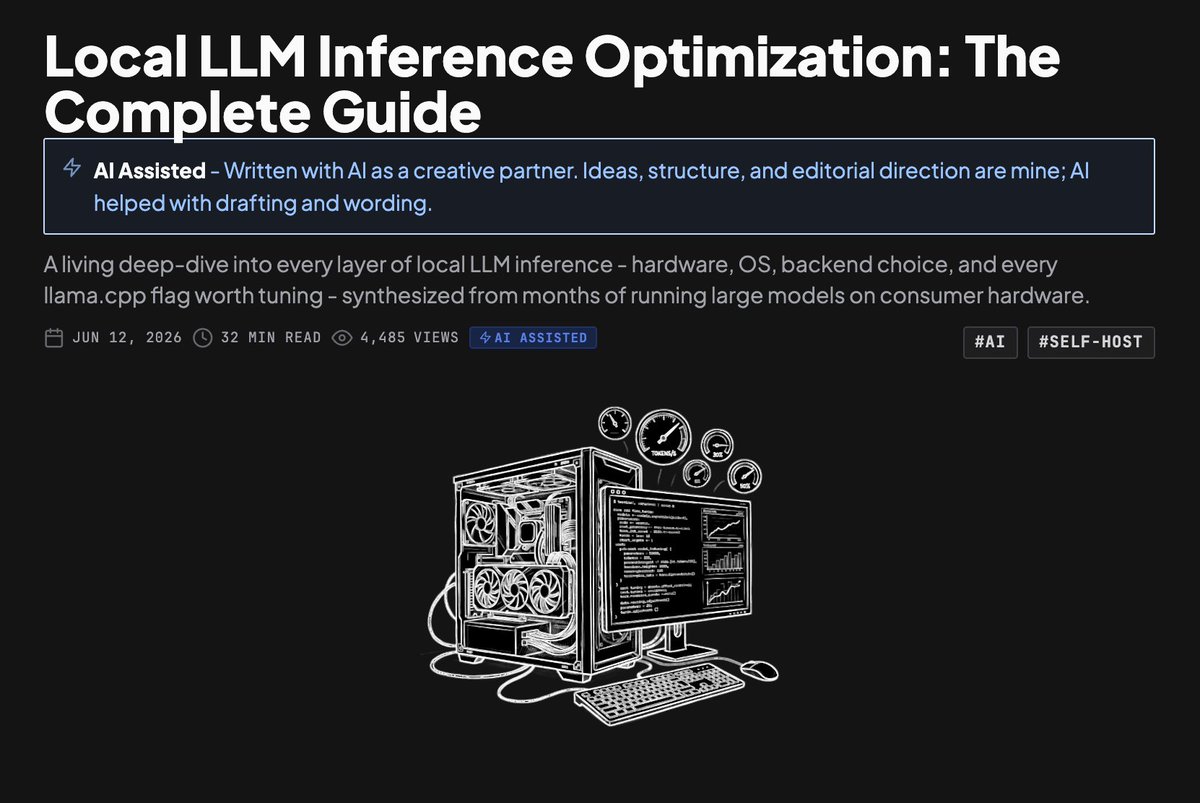
Sakana AIhttps://sakana.ai/fugu-release/Lokal inference-sporet fik også en solid reference. Ikke glam, bare den slags llama.cpp/VRAM/KV-cache-nørderi der gør lokale modeller brugbare i praksis.
Recommended read: everything you need to run LLMs optimally (using llamacpp) on your local hardware is in this article. https://t.co/XLRTkqWdEk https://t.co/QsOKftCpQS

Agenter skal kunne finde og betale for ting
Stripe Directory er lille, men vigtigt. Hvis agenter skal bygge rigtige systemer, skal de kunne opdage leverandører, læse strukturerede resultater og betale programmatisk. Kedelig plumbing. Altså: fremtiden.
introducing, the @stripe directory: from the cli, people and agents can search for, and pay, businesses on stripe. > stripe search "serverless postgres database" - payments between two stripe users are free - includes mpp and projects services - join by creating a profile =>
Stripe gør virksomheder, machine-payment endpoints og Stripe Projects søgbare fra CLI med JSON-output til agenter. Det er agent-discovery med betalingsskinner, ikke endnu en chatbot med blazer.
Stripe Docshttps://stripe.directoryNyhedsbonus
Bonus uden for feedet: få friske ting der matcher dagens signal.
TechCrunch’ vinkel på Patch the Planet: Trail of Bits som code-EMT’er for open source-maintainere, med Codex Security i værktøjskassen.
TechCrunchhttps://techcrunch.com/2026/06/22/openai-launches-new-initiative-to-help-find-and-patch-open-source-bugs/Noam Shazeer til OpenAI og John Jumper til Anthropic fik Alphabet-aktien ned. Talentmarkedet er stadig den mest brutale benchmark-suite.
Quartzhttps://qz.com/alphabet-stock-google-ai-researchers-openai-anthropic-062226Nvidia kan reducere vandforbrug inde i datacentret, men strømproduktion og chipproduktion er stadig den store skjulte regning. Irriterende fysisk verden, den bliver ved.
TechCrunchhttps://techcrunch.com/2026/06/22/nvidia-wants-to-cut-data-center-water-use-but-thats-not-the-same-as-fixing-ais-water-problem/