Dagens Vibes · 1. juli 2026

Dagens Vibes — 1. juli 2026

Dagens hovedvibe: agents bliver til arbejdsinfrastruktur. Ikke kun “skriv noget kode”, men loops, primitives, personlige OS’er, reviewer-agents og små sikkerhedsmareridt i browserens mørke gyde.

Fra X-feedet

Feedet havde én klar retning: agent-æraen er ved at forlade demo-scenen og flytte ind i produktdesign, teamflow og drift. Romantikken dør; værktøjerne bliver nyttige. Smukt, på den industrielt grå måde.

1. Loop engineering bliver arbejdsformen

Andrew Ng satte ord på dagens største mønster: agents er ikke bare et værktøj, men en række loops med forskellig rytme. Hurtig kodning, langsommere menneskelig styring og ekstern feedback. Kedeligt navn, farlig nyttigt.

Andrew Ng
@AndrewYNg

“Loop engineering” is a hot buzzphrase after mentions of it by Boris Cherny (Claude Code’s creator) and Peter Steinberger (OpenClaw's creator) went viral on social media. Loops are now a key part of how we get AI agents to iterate at length to build software. In this letter, I’d like to share my 3 key loops, shown in the image below, for building 0-to-1 products. These loops guide not just how I build software, but also how I decide what software to build. Agentic coding loop: Given a product specification and optionally a set of evals (that is, a dataset against which to measure performance), we can have an AI agent write code, test its work, and keep iterating until the code is bug-free and meets its specification. This idea of closing the loop took off around the end of last year, and it has been a game changer in enabling coding agents to work longer productively without human intervention. For example, over the weekend, I was building an app for my daughter to practice typing, and my coding agent could easily work for around an hour, using a web browser to check what it had built multiple times before getting back to me, without needing my intervention. The engineering loop executes quickly. Every few minutes, the coding agent might build and test a new version of the software. I hear frequently from developers who are finding new ways to engineer more effective engineering loops. This is an active area of invention! Developer feedback loop: In this loop, a developer examines the current product and steers the coding agent to improve it. Last year, a lot of developers (including me) were acting as the QA (quality assurance) function for our coding agents, manually finding bugs and then asking the agent to fix them. But with coding agents much more able to test their own code, the amount of time we need to spend on this function has decreased significantly. This allows us to make higher-level product decisions, such as what key features to offer, where the UI needs improvement, and so on. The developer-feedback loop operates over time intervals between tens of minutes and hours — that's how frequently a developer might review a product and give feedback. In the case of the typing app, I changed my mind a few times about the visual design, what cat costumes she can unlock as she learns (she loves cats), and the user flow for a grown-up to log in and steer the child's learning experience. When a developer has a clear vision for what to build, it is still a lot of work to translate that vision into a specification for a coding agent to implement. Further, after the developer has seen an implementation, they might update (or perhaps clarify) the spec to steer it toward what they want. If you find that the system repeatedly runs into certain problems, building a set of evals for the agent becomes useful. AI-native teams are increasingly using AI to help shape product direction, for example, automating the gathering and analysis of usage data, summarizing written and verbal customer feedback, or carrying out competitive analysis. However, for pretty much all the products I’m involved in, I see humans as having a significant context advantage over current AI systems — we know a lot more than the AI system about the users and the context the product has to operate in — and thus humans play a critical role. Many people describe this human contribution as “taste,” but I prefer to think of it as humans having a context advantage, since that gives us a clearer path to helping AI systems get better. This also speaks to why this step can’t be automated: So long as the human knows something the AI does not, human-in-the-loop is needed to to inject that knowledge into the system. External feedback loop: This includes a wide range of tactics like asking a few friends for feedback, launching to alpha testers, or putting the code into production with A/B testing. These tactics are usually slow, rarely taking less than hours and sometimes taking days or even weeks. This data informs the developer vision, which in turn continues to drive the detailed product spec, which in turn drives the coding agent. With coding agents speeding up software development, more engineers are starting to play a partial product management role. For many engineers who are growing into this role, the hardest part is shaping the product vision and striking a balance between building (bridging the gap between vision and spec) and getting user feedback to evolve the vision. It is important to do both! I will write more about how to do this in future posts, but for now, I find it encouraging that engineers are playing an expanded role (just as product managers and designers now do more engineering). [Original text: The Batch]

Tweet media
♥ 4.1k · ↻ 747 · 💬 158 · 🔖 5.3k
https://x.com/AndrewYNg/status/2071988145667928442

2. Produktet skal være en primitive, ikke en featurebuffet

Amplify-teksten ramte feedet hårdt: agents vil ikke klikke rundt i din SaaS-labyrint, de vil have stabile capabilities. Det er devtools-tænkning som produktstrategi — og ja, Pi bliver nævnt som eksempel. Diskret fanfare i maskinrummet.

Dillon Mulroy
@dillon_mulroy

“Features are a liability for agents. Every feature expands the decision space an agent must reason about. More features mean more edge cases, more ambiguity, and more failure modes.” so good, thank you for writing this @lennypruss

Referenced: Lenny Pruss @lennypruss

You can read a more in depth version in my latest post: https://t.co/O2rdSzyeNs Thanks to @davidcrawshaw, @mitchellh, @armon, @schrockn, and @jthandy for pressure-testing these ideas!

https://x.com/lennypruss/status/2071980188955742530
♥ 164 · ↻ 6 · 💬 7 · 🔖 88
https://x.com/dillon_mulroy/status/2072059078273290284

3. PM-rollen flytter tættere på kode, data og agents

Lenny peger på PM’en som prototypebygger og agent-operatør. Det er en ret klar advarsel til koordinator-rollen: hvis du kun flytter tekst mellem møder, kommer robotterne efter din stol først.

Lenny Rachitsky
@lennysan

For years, the PM job drifted toward coordinating and aligning people and their work. That version of the role is fading. Today, the best PMs at the best companies are prototyping with real code, querying data conversationally with MCP, confidently running coding AI agents, and finding countless ways to increase their leverage with AI. In today's highly tactical guest post, Colin Matthews (my new Head of Education!) shares a forward-looking framework on how the most AI-native PMs are operating in mid-2026, and how you can create much more leverage for yourself with AI. Don't miss this one: https://t.co/ic3sA16ooz

Tweet media
♥ 216 · ↻ 19 · 💬 17 · 🔖 218
https://x.com/lennysan/status/2072056417692058022

4. Personlige agent-miljøer bliver små OS’er

Matt Pococks wiki-eksperiment er ikke bare notetagning. Det er en master-controller på tværs af repos, Todoist og informationsstrømme — præcis den type hverdagsinfrastruktur der begynder som hack og ender som nervesystem.

Matt Pocock
@mattpocockuk

One unexpected outcome of this is that I'm now using the wiki as the ONLY place I run Claude Code I use it as a master controller for all of my repos, kicking off cross-repo tasks and using Todoist as a task tracker Interesting

Referenced: Matt Pocock @mattpocockuk

Doing my first ever experiments with a personal, entirely agent-managed Karpathy-style wiki X, Discord, Gmail are all being ingested into it every few hours This is the knowledge base that will serve as the environment for all of my future loops

https://x.com/mattpocockuk/status/2071607607714890181
♥ 627 · ↻ 14 · 💬 70 · 🔖 561
https://x.com/mattpocockuk/status/2071901405690949874
Matt Pocock
@mattpocockuk

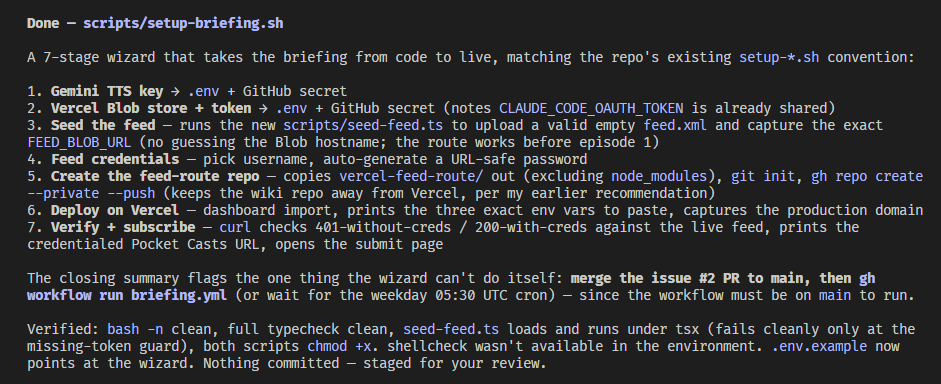
Getting sick of setting up third-party services So I built a skill for it /wizard builds you an interactive CLI for the task you're currently doing, and takes as much work off your hands as possible #1 is how the agent described the wizard, #2-3 is what it looks like: https://t.co/SwMnQOeqX8

Tweet media
♥ 799 · ↻ 28 · 💬 29 · 🔖 894
https://x.com/mattpocockuk/status/2072042214188847178

5. Agents skal vise arbejdet, ikke bare sige “trust me bro”

Simon Willisons shot-scraper-video er et virkelig godt lille stykke agent-infrastruktur: lad agenten optage en demo af den feature den byggede. Det er QA, dokumentation og pitch i én YAML-fil med arbejdshjelm.

Simon Willison
@simonw

I've added video support to my "shot-scraper" browser automation tool - you (or your coding agent) can now create a storyboard YAML file and use that to record a video demo of new web application features https://t.co/NfRtrvplBf

♥ 90 · ↻ 10 · 💬 13 · 🔖 82
https://x.com/simonw/status/2072001270978855074

6. Teamflowet skal designes til agent-støj

David Fowler viser den jordnære ende af vibe coding: en intern PR-app der skærer 180 åbne PRs ned til en fælles kø og holder drafts væk fra review. Agents gør ikke proces overflødig; de gør dårlig proces mere højlydt.

David Fowler
@davidfowl

We built this beautiful, vibe-coded app to manage the day-to-day operations of @aspiredotdev. The main thing it solved for the team over the default @github PR view is a *shared* view across multiple repositories. Individuals do not get to control the order, it is team managed (PS: Everyone seems to be bad at managing Github notificaiton noise). We only show 10 PRs (max) at a time. This reduces the mental load of scanning through at 180 open PRs (or only looking at the most recent set). Knowing which 10 to show is always tricky and we keep tweaking it, but it's working well. We also filter out draft PRs by default. With the advent of coding agents, we want the team to spend 20% of their time dreaming up big things but 80% working on the next milestone. Draft PRs are pure noise, prototypes and un-ready experiments. They should not distract. The next policy we put in place is to make it so that PRs never show up for review until: - Checks are green - All review feedback is resolved Unfinished work pushes the PR back into the individual user's focus queue and out of the shared one. Cherry on top, we made it a PWA and added support for desktop notification so we can nag people (responsibly) for reviews. cc @depoll 😅

Tweet media
♥ 95 · ↻ 10 · 💬 11 · 🔖 41
https://x.com/davidfowl/status/2071814829971833066

7. AI-metrics skal måle brugerens verden, ikke vendorens konfetti

Mitchell Hashimoto havde dagens nødvendige kolde spand vand: deploys per dag og AI-assisterede PRs er ikke det samme som bedre software. Spotify som case er næsten for nem — men stadig morsom på den dyre måde.

Mitchell Hashimoto
@mitchellh

Amongst my friends, Spotify is the lowest quality consumer app we still pay for. It certainly hasnt gotten noticeably better in the last couple years (arguably worse). So, this is not the positive look Ant and Spotify are spinning here. Bigger picture, this is the problem with a lot of AI reporting. It reports completely meaningless metrics like deploys per day or LoC. Why don’t we start reporting consumer satisfaction reports? Actually end state research results. All the no nuance AI people always come out and think that this is anti AI. Again, I think AI is great and Claude is great. But this is bad marketing and makes both look like clowns.

Referenced: ClaudeDevs @ClaudeDevs

Boris sat down with Spotify VP of Engineering Niklas Gustavsson. Spotify ships 4,500 production deploys a day, and 73% of PRs are now AI-assisted. https://t.co/Bc0xPduumG

https://x.com/ClaudeDevs/status/2071671418245492926
♥ 6k · ↻ 422 · 💬 282 · 🔖 714
https://x.com/mitchellh/status/2071971627748020409

8. Inference er stadig krigen under det hele

Etched-historien var dagens store compute-signal: hvis agents skal arbejde konstant, bliver tokenproduktion en industriel kapacitet. “Whoever produces the most tokens wins” er måske lidt VC-trompet, men trompeten peger mod noget rigtigt.

Patrick OShaughnessy
@patrick_oshag

Three years ago, two Harvard dropouts set out to build a better AI chip than the largest companies in the world. Almost everyone I called at the time said it was impossible. Today, Etched (@Etched) comes out of stealth with $800M total raised, $1B in signed customer contracts, and a working next-gen AI chip. This was my excuse to ask the two founders, @UbertiGavin and @robertwachen, every question I have about compute and inference. We discuss: - Why they built an entire rack and not just a chip - The two technical bets behind their architecture no one else has tried - How two founders in their twenties recruited industry legends - The night they nearly ran out of money - Why whoever produces the most tokens wins If you care about the future of compute, Gavin and Rob are two people to know. I think you will find the story of what they have built hard to forget. Enjoy! TIMESTAMPS 0:00 Intro 1:00 Why Nobody Believed Etched Would Work 14:06 Why Inference Is the Bottleneck 22:27 Gavin and Rob’s Origin Stories 33:24 Taking Huge Risks to Move Faster 49:43 Kernels, Compilers, and the AI Stack 1:02:08 Raising $100M to Survive 1:16:00 The Future of Models, Agents, and Intelligence

Tweet media
♥ 1.5k · ↻ 137 · 💬 36 · 🔖 1.6k
https://x.com/patrick_oshag/status/2071972025896489452

9. Sikkerhedsdesserten: gratis VPN, dyr clipboard

Feross/Socket fandt VPN-extensions der læste clipboard hvert halve sekund. Det er ikke en feature, det er en lommetyv med toolbar-icon.

Feross
@feross

A VPN extension is not supposed to read your clipboard every 500 milliseconds.

Referenced: Socket @SocketSecurity

A VPN extension is not supposed to read your clipboard every 500 milliseconds. Socket researchers found Chrome and Firefox extensions posing as free VPNs that added clipboard stealers in later updates and exfiltrated copied data. https://t.co/3inl8VFOgc

https://x.com/SocketSecurity/status/2071716312192032918
♥ 88 · ↻ 6 · 💬 2 · 🔖 13
https://x.com/feross/status/2071903300220268565

Nyhedsbonus

Udenfor feedet var den stærkeste nyhedsvinkel AI-for-science og infra-håndværk: mindre glimmer, mere “kan det reproduceres og debugges?”