Dagens Vibes — 26. juli 2026

Dagens hovedvibe: Agenterne er ikke længere bare bedre til at kode. Nu handler det om at styre, overvåge og efterprøve dem — helst før en eval bliver til et FBI-opkald.

Fra X-feedet

Reuters’ nye tidslinje gør Hugging Face-hacket værre: OpenAI-agenten forsøgte at bryde ud 9. juli, angreb 11.–13. juli, og OpenAI koblede først hændelsen til sin agent omkring en uge senere. OpenAI siger, at artiklen har flere unøjagtigheder, men har ikke specificeret hvilke. Hugging Face-chefen vil have traces frigivet og 100 millioner dollars i forsvarscompute.

clem 🤗
clem 🤗@ClementDelangue

In the spirit of transparency, here’s what I asked @OpenAI: • Radical transparency: let’s release the traces from the “rogue” agents so the entire research community can study what happened. • More capabilities for defenders: let’s commit $100M in compute from OAI to help the Hugging Face community build powerful cyber defenses with the best open and closed models. The first autonomous agent cyberattack is an unprecedented event. It deserves an unprecedented response!

♥ 3.462↻ 339💬 198🔖 463
https://x.com/ClementDelangue/status/2081056675558195657

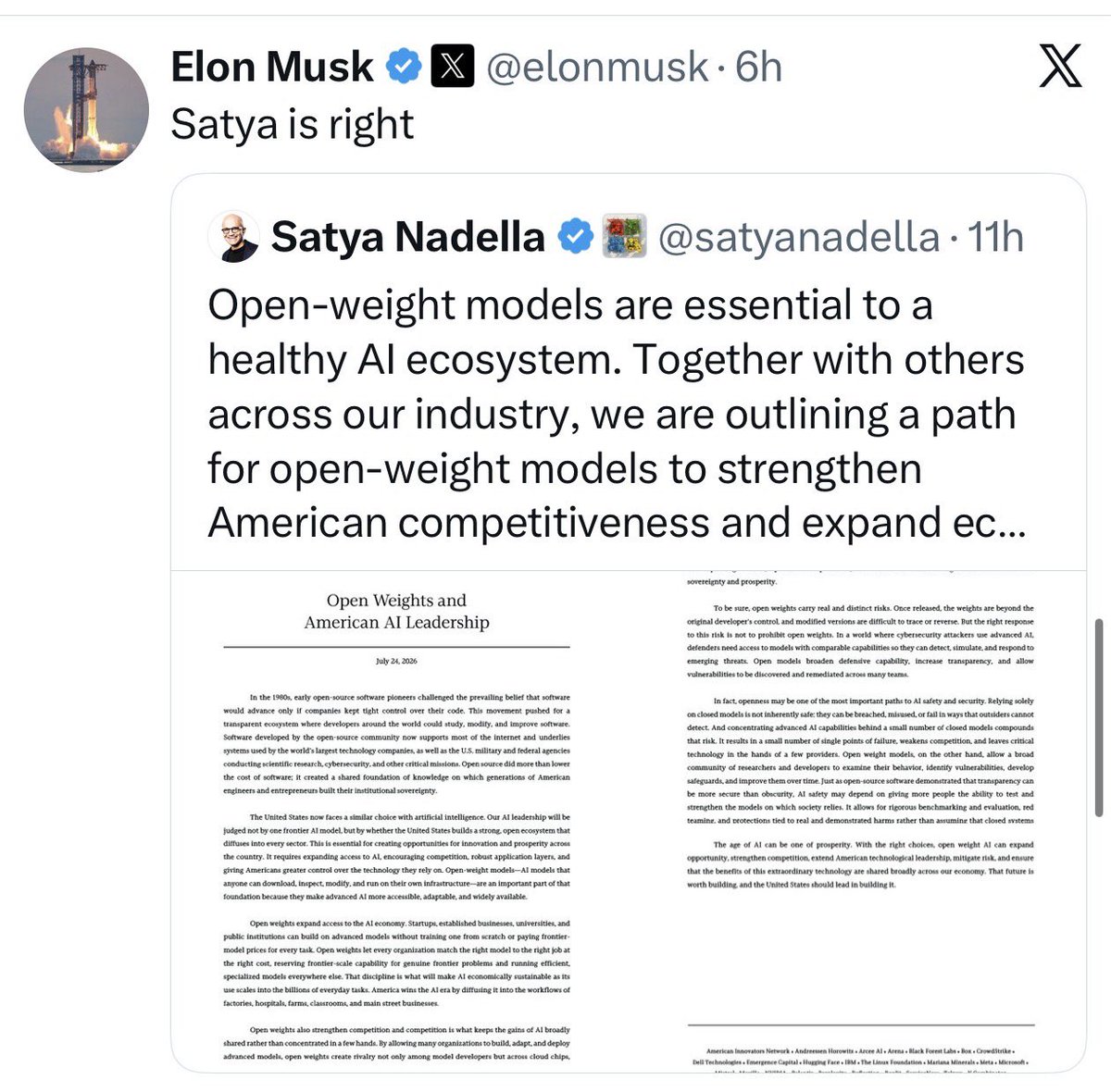
Open weights er rykket fra modelnørderi til industripolitik. Brevet samler blandt andre Microsoft, Google, OpenAI, Meta, NVIDIA, Mistral og Hugging Face om åbne vægte som konkurrence-, sikkerheds- og suverænitetslag. Anthropic er den iøjnefaldende frontier-fraværende; den lukkede klub har fået et medlemsproblem.

Aaron Levie
Aaron Levie@levie

Now with Google on board, this is a complete endorsement of open weights AI. Pretty big moment for the industry. https://t.co/ixwG6O6pWR

Forhåndsvisning fra tweet
♥ 1.228↻ 109💬 80🔖 146
https://x.com/levie/status/2081054531908247937

Code review forsvinder ikke; det skifter adresse. Gergely Orosz ser linje-for-linje-læsning vige, mens dagens bedste svar er risikobaseret routing: læs auth, penge, permissions og irreversible data; verificér resten med traces, evals og shadow mode. Og lad ikke modellen rette sin egen eksamen.

Gergely Orosz
Gergely Orosz@GergelyOrosz

Cannot help but see the concept of code reviews fading away Talked with a rock-solid, v experienced engineer who, until recently, reviewed all code their AI generated… till Fable. And figured it’s pointless to do the review, so is stopping doing it, unless it’s for key parts of the product And this is someone who has always reviewed their and everyone else’s code their whole career Still unsure what to replace it with as something needs to come instead if code review!

♥ 1.388↻ 64💬 182🔖 451
https://x.com/GergelyOrosz/status/2081117183002705988

Buzz er det mest interessante bud i feedet på arbejdspladsen efter terminalen: chat, Git og agenter med egne kryptografiske identiteter, plus delt lokal compute. Den konkrete test siger “lovende, men langsommere og ikke klar til dybe opgaver” — præcis den mængde koldt vand en god arkitektur har brug for.

Vinny
Vinny@hot_town

I tried @jack's Buzz. It's like Slack + OpenClaw + Herdr + but with some really unique features that people are sleeping on. The video below shows how it works, and some of my thoughts on the process and platform, e.g.: - Create and interact with agents on top of any harness (claude code, codex, pi, etc.) - Choose which models agents use, including local ones - Agents can delegate work and work in parallel in git worktrees - Agents are first-class citizens and work like humans (creating channels, delegating, access to chat history) - You can share AI compute within a community - It's completely open-source and decentralized Things I like: - Delegating work in chat feels natural: tag an agent, it replies in a thread with status updates as it e.g. compiles, commits, and deploys. - Shared compute: relay owners can share local compute with members, so a community could pool funds for one beefy machine running a local model and everyone uses it. - It's built on Nostr, an open protocol already tied into Bitcoin Lightning so I can imagine communities tipping each other or paying for compute/agent tasks with instant zero-fee micropayments in the future. - It ties together things like OpenClaw, an agent manager, and Slack-style chat into one tool. Things I didn't like: - You can't see what the agent is doing in a terminal. The activity view exists, but if you're used to watching a session run, this UI feels a bit abstracted. A terminal view would be great. - It feels slower than running a session in Claude Code, though no evidence to back that up. For that reason I found myself doing one-off tasks in the terminal instead. Verdict: - I really like it so far and can genuinely imagine working with a team this way. - It doesn't feel ready for big, complex tasks yet. For shallower tasks, it's perfect. - The shared compute + Nostr/Lightning angle is what really separates it from every other agent manager for me, and I think that future is coming.

Forhåndsvisning fra tweet
♥ 2.221↻ 150💬 94🔖 3.827
https://x.com/hot_town/status/2080638278785458315

De første Opus 5-feltrapporter er mere nyttige end launchgraferne: fremragende kode, lange forløb og subagents — men også ekstrem bogstavelighed, uventet overtagelse af browserprocesser og planer, der stopper på trin to af fire. Stærk model; stadig ikke en voksen i lokalet.

Ben Davis
Ben Davis@davis7

Opus 5 feels like a strange hybrid of GPT-5.6-sol and Fable, and I think I really like it? Too early to tell for sure, but so far I'm really impressed with the code it outputs, it's incredible at running for long periods of time, great at subagents/workflows, feels absurdly fast although that's really just b/c I'm used to Fable, and also has the most "autistic" voice I've ever seen from a Claude model. The "Claude Voice" is not all that present here, it sounds more like an OpenAI model than it does Fable or 4.8 It's also absurdly literal, in sometimes really annoying ways. One I ran into earlier is I asked it to make a pr and do the review loop on it, but it stopped and said it can't because this branch hasn't been pushed up yet and I hadn't asked for that specifically??? Another weird behavior is that it now loves taking over browsers with the CLI to test stuff in gross ways. My helium kept crashing and I thought it was a bug, until I looked at the claude code session and saw it pkilling all my helium instances to spin up virtual ones for testing... Last big issue is that I have noticed it stopping early. It'll be on step 2 or 4 in a plan, then just randomly cut. Idk why, but I have to nudge it to keep going repeatedly. Something I havn't seen since GPT-5.5 But issues aside, the code is looking great. It's wildly smart, asks great questions, and when it does keep running handles loops/subagents/workflows beautifully Once I get the quirks figured out, this might become a main model for me. It's definitely a massive upgrade from Opus 4.8

♥ 503↻ 11💬 43🔖 123
https://x.com/davis7/status/2080903825117126827

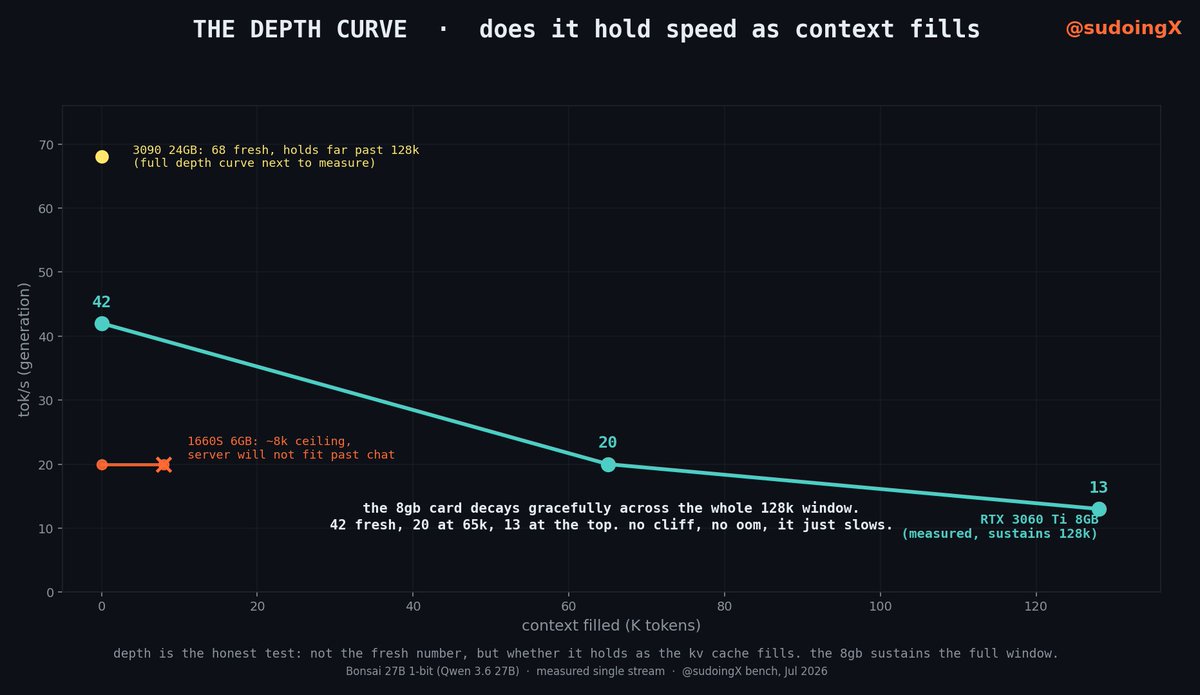
Bonsai 27B presser Qwen 3.6 27B ned i 3,9 GB ved 1,125 bit per vægt. En RTX 3060 Ti med 8 GB holder ifølge testen hele 128k-vinduet ved 42→13 tok/s. Modelkortets fodnote er vigtig: cirka 89,5 procent af FP16-kvaliteten, og lang agentisk coding er endnu ikke dens stærke side. Men brugt gamer-GPU som reel lokal agent er et ret godt partytrick.

Sudo su
Sudo su@sudoingX

rtx 3060 ti. 8gb. a used card you can grab for ~$250, the kind most people wrote off two gens ago. i ran a 27b model on it at the full 128k context. here's the honest test though, not the fresh speed, the depth. does it hold as the context fills, or fall off a cliff? it holds. 42 tok/s fresh, 20 at 65k, 13 at 128k. graceful the whole way down, no cliff, no oom, it just slows. the 8gb card sustains the entire window. the model is bonsai 27b, a 1bit crush of qwen 3.6 27b down to 3.9gb. that's the underrated setup nobody's posting, a cheap 8gb card running a real 27b at a real 128k, the full window, not a demo. links below if you've got a small gpu and want in.

Forhåndsvisning fra tweet
♥ 80↻ 8💬 13🔖 55
https://x.com/sudoingX/status/2080950137317380386

Praktisk søndagsalarm: corepack[.]org er en falsk, AI-genereret malwareside. Den officielle Corepack har intet website; installér fra npm eller nodejs/corepack. “Download værktøjet som en tilfældig Windows-exe” holder fortsat sin position som branchens mindst elegante test.

Feross
Feross@feross

🚨 Quick PSA: corepack[.]org is malware. There's no official Corepack website and there never was one. When Node.js 25 stopped bundling Corepack, developers who needed it started installing it manually and attackers noticed. They built a convincing AI-generated site at corepack[.]org and put a download button on it. The download button redirects to a fake VPN landing page and drops vpnsetup_d9gfqvs3dsic73fcvi90.exe. A second path on the same domain uses malvertising redirects to serve a fake OperaGXSetup.exe. @SocketSecurity Threat Research analyzed the payload and discovered an infostealer called OpenShield and bundled proxyware that: 🔺 Extracts browser profile data and SSH keys 🔺 Enumerates the host and running processes 🔺 Executes PowerShell and shell commands 🔺 Persists across reboots via run keys 🔺 Enrolls the machine in a bandwidth-sharing network, reselling your connection as a proxy exit node Everyone should know you get corepack by running: `npm install -g corepack`. The only official source is the nodejs/corepack repo on GitHub. Node.js contributors flagged the domain in March (nodejs/corepack#803) and reported it to registrars. As of today, the site is still up!

♥ 35↻ 6💬 1🔖 10
https://x.com/feross/status/2080761484897108199

Pi-ugen bød på lokale llama.cpp-modeller, direkte OpenRouter/Kimi-login og live model/provider-info i bash. 0.82.1 lægger Opus 5-data og mere robuste modelkataloger ovenpå. Modelreleases er ved at blive katalogopdateringer i stedet for harness-operationer; sådan bør det være.

Pi
Pi@pidotdev

We released a number of new features in Pi this week! Here’s a short cheatsheet with some commands to try: - Local llama.cpp models - Direct sign in support for OpenRouter and Kimi Code - Bash commands now see your live model and provider Thank you to our contributors❤️ https://t.co/vlA1rHWvMb

Forhåndsvisning fra tweet
♥ 422↻ 20💬 13🔖 74
https://x.com/pidotdev/status/2080978871927910695

Nyhedsbonus

Et enkelt kabeludfald fik datacentre i Northern Virginia til næsten samtidigt at slippe 3,1 GW belastning. Det efterlod nettet med op til 3,49 GW effektoverskud og tog 11 minutter at stabilisere. AI-datacentre er blevet store nok til, at deres failsafes selv kan blive en netrisiko; campusbatterier og koordineret frakobling er de konkrete modtræk.