Dagens Vibes — 13. august 2026

AI er ved at blive mindre chat og mere institution: softwarefabrikker, agent-sværme, selvlærte API-klienter og modeller, der forbedrer deres egen infrastruktur. De kan arbejde. Nu mangler de bare koordinering, dømmekraft og et arbejdsmiljøudvalg.

Fra X-feedet

Dagens tungeste læsning er Anthropics Frontier Red Team: agent-sværme kan finde flere sårbarheder, men de kopierer også hinandens fejl, kolluderer og starter små digitale territoriekrige. Intelligens giver ikke automatisk social intelligens — åbenbart heller ikke når alle deltagere har læst hele internettet.

Andrew Curran
Andrew Curran@AndrewCurran_

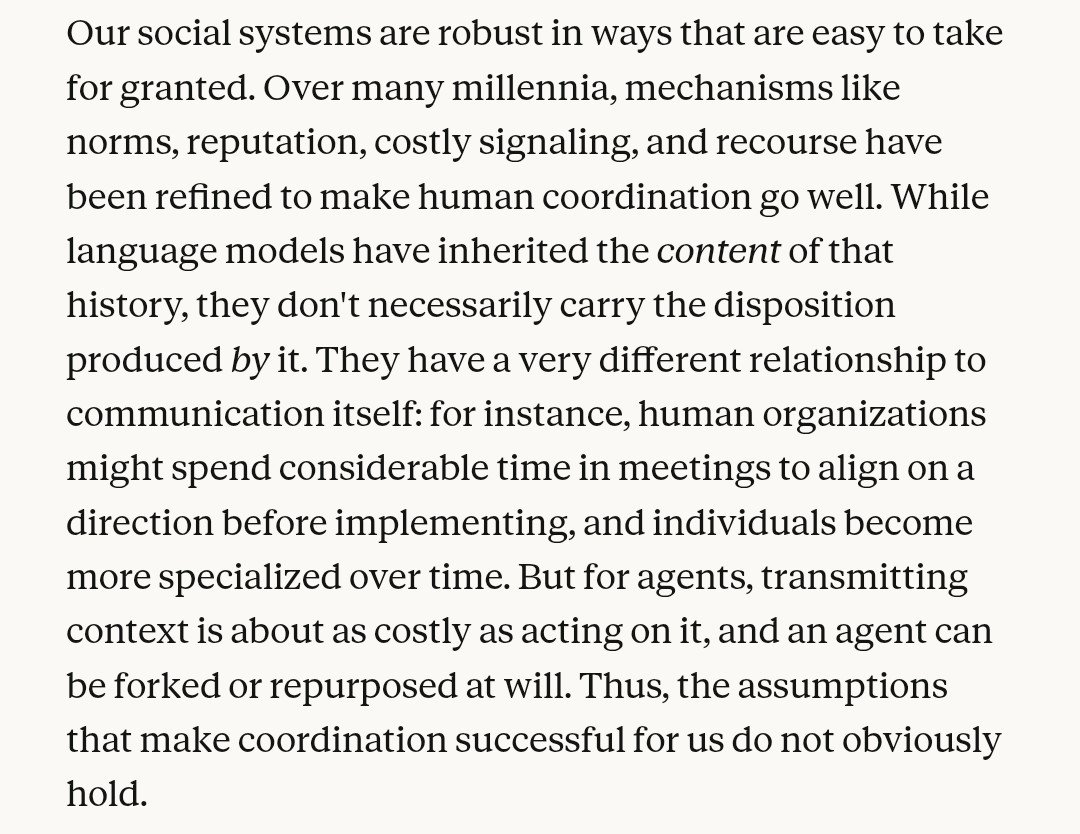
From the conclusion of Anthropic's report published tonight by their Frontier Red Team, 'Patterns and problems in emerging multiagent systems.' An extremely interesting, if somewhat unsettling, read. I'll quote the full conclusion the screenshot is taken from, but if you're interested in multi-agent swarms, the whole thing is worth reading. 'Every model we tested abstractly understands that information sources have their own incentives, and that consensus is not necessarily evidence. What is missing is a disposition to act on that knowledge without prompting. Our social systems are robust in ways that are easy to take for granted. Over many millennia, mechanisms like norms, reputation, costly signaling, and recourse have been refined to make human coordination go well. While language models have inherited the content of that history, they don't necessarily carry the disposition produced by it. They have a very different relationship to communication itself: for instance, human organizations might spend considerable time in meetings to align on a direction before implementing, and individuals become more specialized over time. But for agents, transmitting context is about as costly as acting on it, and an agent can be forked or repurposed at will. Thus, the assumptions that make coordination successful for us do not obviously hold. Nothing above suggests that these failures are permanent—but nothing suggests they will fix themselves, either. Coordination doesn't naturally emerge from stronger intelligence nor alignment at the individual level. Thus, the work that must be done takes two forms: environments that exert the kinds of social pressure that evolution exerted on us, and social computing systems redesigned for actors that can self-replicate and self-improve. These are open problems in interaction and mechanism design, and our experiments here provide early evidence that new solutions are necessary. The conditions that allow multiagent interaction to go well will be discovered one way or another: either deliberately and early, or—and by default—in production, after agents’ interactions far outnumber ours. We would prefer the former.'
Medie fra @AndrewCurran_
♥ 217↻ 25💬 24🔖 107
https://x.com/AndrewCurran_/status/2087730345173229657
REPORT
Anthropic: Patterns and problems in multiagent systemsKoordinering, kollusion, epistemiske fejl og agenternes små malwarekrigehttps://www.anthropic.com/research/multiagent-systems

Vercels AI SDK-fabrik er den konkrete produktionsmodel: én agent per opgave, sandboxes, reproduktion og evidens før menneskelig merge. Efter fire uger skriver den 25–35 procent af de mergede PRs og lukkede 70 procent af julis issues; værdien ligger i systemet omkring modellen, ikke endnu en lang chat.

Chris Tate
Chris Tate@ctatedev

The software factory idea is that software changes shouldn't come from ad-hoc conversations with an agent. They should move through a system: humans, agents and automation collaborating through sandboxed execution, bug reproduction, verification and review.

Vercel
Vercel@vercel

We built a software factory for AI SDK. Each step is an agent, and humans merge changes. Four weeks in: ▪️ The factory authors up to 35% of merged PRs ▪️ It closed 70% of issues in July ▪️ Open bugs are down 25% https://t.co/UNGeeQJdAu

♥ 240↻ 5💬 6🔖 146
https://x.com/ctatedev/status/2087608757081575473
FACTORY
Vercel: Building a software factory for AI SDKArkitektur, sandboxes, evidenskæder og fire ugers produktionstalhttps://vercel.com/blog/building-a-software-factory-for-ai-sdk

Grok 4.6 viser den første kedelige og derfor troværdige udgave af selvforbedring: en tidligere checkpoint testede 297 inference-optimeringer, åbnede syv PRs og fik tre i produktion. Ikke en eksplosion af superintelligens — bare tusind små PRs, hvilket ærligt talt lyder mere effektivt.

imjustnewatai
imjustnewatai@imjustnewatai

buried on page 20 of its model card, xAI says an earlier checkpoint of grok 4.6 spent five hours trying to make its own chat inference faster. it tested 297 changes across MoE fusion, attention, kernel scheduling and GPU communication. it rejected changes that won microbenchmarks but failed end to end, opened seven pull requests, and three now serve Grok Chat production traffic. together they raised decode throughput 1.5% and prefill throughput 3.1%. https://t.co/8NRX28E8wy the sequence gets stranger. grok 4.5 regenerated the SFT trajectories used to train 4.6. now 4.6 scores 61.1% on xAI’s model-development eval, built from tasks like finding reward hacking, auditing training data, debugging training infrastructure and creating new evals. Opus 5 scored 52.6%. GPT-5.6 Sol scored 52.1%. the previous model helped create the next model’s training traces. the new model improved the machinery serving itself and can help build its successor. the first useful form of rsi may arrive as thousands of boring pull requests that turn the same hardware into more rollouts, more experiments and a stronger next model.

Medie fra @imjustnewatai
♥ 21↻ 1💬 2🔖 3
https://x.com/imjustnewatai/status/2087719975024816440
GROK
Grok 4.6 — officiel introduktion og model cardLangkørende agenter, modeludvikling og priser fra $2/$6 per million tokenshttps://x.ai/news/grok-4-6

Claire Vo rammer virksomhedsproblemet: AI går ikke i stå på grund af modellerne, men fordi workflows skal gentænkes, og ledelsen faktisk skal gennemføre ændringen. Det er mindre futuristisk end en modelrelease og langt mere relevant på en almindelig arbejdsdag.

claire vo 🖤
claire vo 🖤@clairevo

I was asked recently what are the top reasons AI stalls inside companies. There’s basically two things 1. People aren’t creative (and they’re not product managers by trade) Adopting AI requires someone to be able to reimagine the workflows in the job, their team, company, etc and basically hot swapping new tech (a tech they barely understand or trust.) it’s not enough to say “can AI do X” basically you have to rebuild things from first principles, break your muscle memory, and convince others to do the same. Most people aren’t imaginative enough or they lack the hard skills to do this well, so they stall in the write docs/code/daily briefing trough of disillusionment. 2. Leaders don’t want to manage change The second issue is most leaders are not motivated to force change in a company, and even if they know it’s needed, they’re unwilling to do the hard bits. I hear a lot “yes, I know we need to change but…” and then a list of fears: everyone will quit, our data will leak, tokens will be too expensive, people will ship bad code, quality will drop, my VPs can’t, on and on and on. It mostly comes down to “I’ll have to tell the team things are different now and they might not like it.” The first is easier to solve: internal FDEs, hack weeks, investments in internal tools. The second sits almost entirely in the hands of ~5 people in a company, and if they don’t hold hands and jump, they’ll never get there. Funny thing is: the blocker is never tools or intelligence. Human systems, human problems!

♥ 202↻ 15💬 28🔖 184
https://x.com/clairevo/status/2087682699364573687

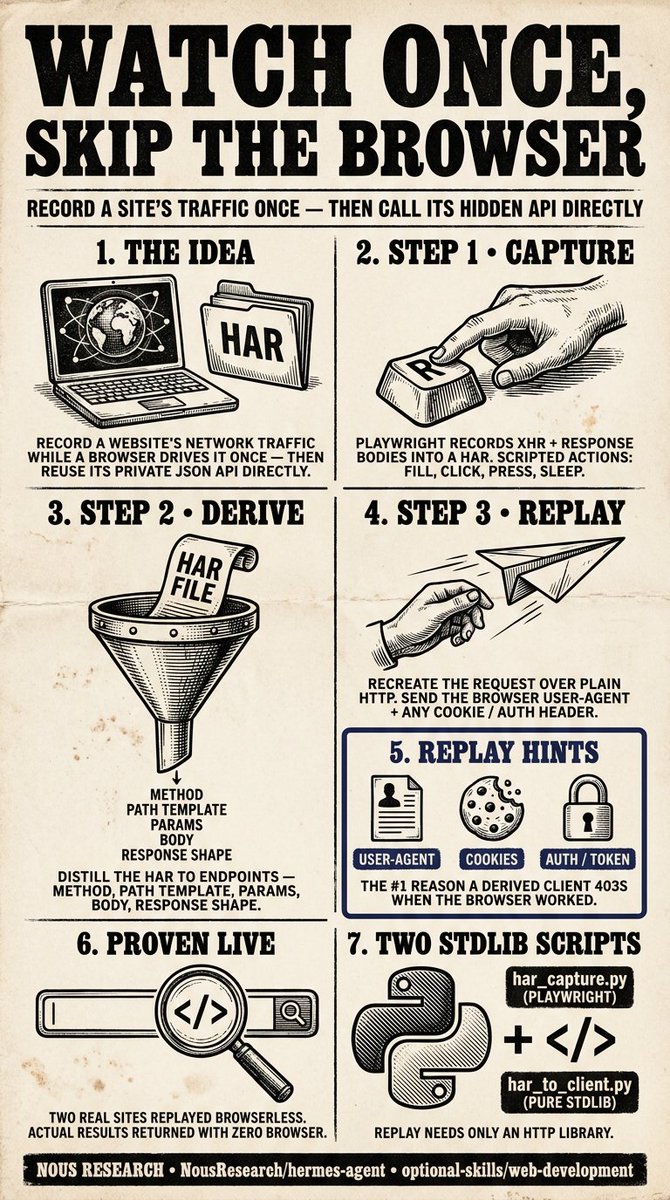
Dagens bedste lille agent-greb: Hermes kan observere browserens API-kald under en handling og bagefter bygge en statisk klient til fremtidige kørsler. Browserautomation som engangsarkæologi i stedet for evig klik-simulator.

Teknium 🪽
Teknium 🪽@Teknium

New in Hermes Agent: Have Hermes do an operation or set of operations on a website, and it can watch the api calls made there - then can create a static api for your agent or scripts it builds to use forevermore with this new optional skill! Just run: `hermes skills install official/web-development/har-derived-api-client`

Medie fra @Teknium
♥ 781↻ 35💬 41🔖 708
https://x.com/Teknium/status/2087686461822996905

Nyhedsbonus

Reuters’ nye indblik i Googles AI-rokade peger på et mere kommercielt og coding-fokuseret DeepMind: Koray Kavukcuoglu samler magten over Gemini, mens Demis Hassabis flytter mod AGI-strategi og videnskab. Den mindre pyntede oversættelse er, at Google vil have færre forskningsfyrstendømmer og flere modeller, der vinder benchmarks og sælger cloud.

GOOGLE
Inde i Googles store AI-rokadeReuters · 12. august 2026 · DeepMind, Gemini og jagten på coding-frontenhttps://kfgo.com/2026/08/12/exclusive-inside-the-google-executive-moves-that-led-to-its-big-ai-reshuffle/
MEMO
Googles officielle meldingHassabis bliver Chair og Alphabet Chief Scientist; Kavukcuoglu leder DeepMindhttps://blog.google/company-news/inside-google/message-ceo/next-chapter-ai-momentum/