Modelracet er gået fra topfart til tegnefilm: Meta og Google lander stærke, billige modeller samme aften, mens Fable 5.1 viser både tænder og taxameter. Under motorhjelmen handler det stadig om det samme: harness, verifikation og hvem der egentlig kan betale for alle de tokens.
Fra X-feedet
Muse Spark 1.3 er dagens tungeste drop. Meta siger 20% færre tool calls og 25% færre tokens end 1.2; den tilgængelige xhigh-variant matcher Sol max på Artificial Analysis til $0,55 per testopgave, mens max ligger lige under Anthropics topmodeller. Og Meta lover åbne vægte. Det er en ret brutal tilbagekomst fra “nå ja, Meta laver også modeller”.
ℏεsam@Hesamation · 3. september · 00:22
Muse Spark 1.3 is now the top non-Anthropic model on Artificial Analysis Intelligence Index:
> same score as Fable 5
> with 12x cheaper output tokens ($4.25/M vs $50/M)
> just 1 point behind Opus 5, 4 points behind Fable 5.1 from YESTERDAY.
I’m especially curious about cost per task, which we don’t have yet for 1.3 Spark (Max), but for xhigh, it is 5.7x cheaper per task than Fable ($0.55 vs $3.14)
it shows how fragile the Anthropic/OpenAI lead is in the race. I’m not sure if a few points of intelligence can justify that much price gap.
and we’re still waiting for Astra, Grok 4.7, Gemini 4.
Gemini 3.8 Flash er Googles tredje Flash på seks uger: $0,75 ind / $3,75 ud, stærke coding-evals og et højere effort-loft. Ethan Mollicks tidlige test er den nyttige bremseklods: meget god og meget hurtig Flash — men ikke en frontier-model forklædt som tilbudsvare. Til gengæld er pris/fart præcis pointen.
Ethan Mollick@emollick · 2. september · 19:31
Had early access to Gemini 3.8 Flash, it is a very good Flash model, but not equivalent to a frontier model, though. Here is Gemini 3.8 Flash's version of the shader with the same prompts (which it provided very quickly) https://t.co/yXyH73BguR
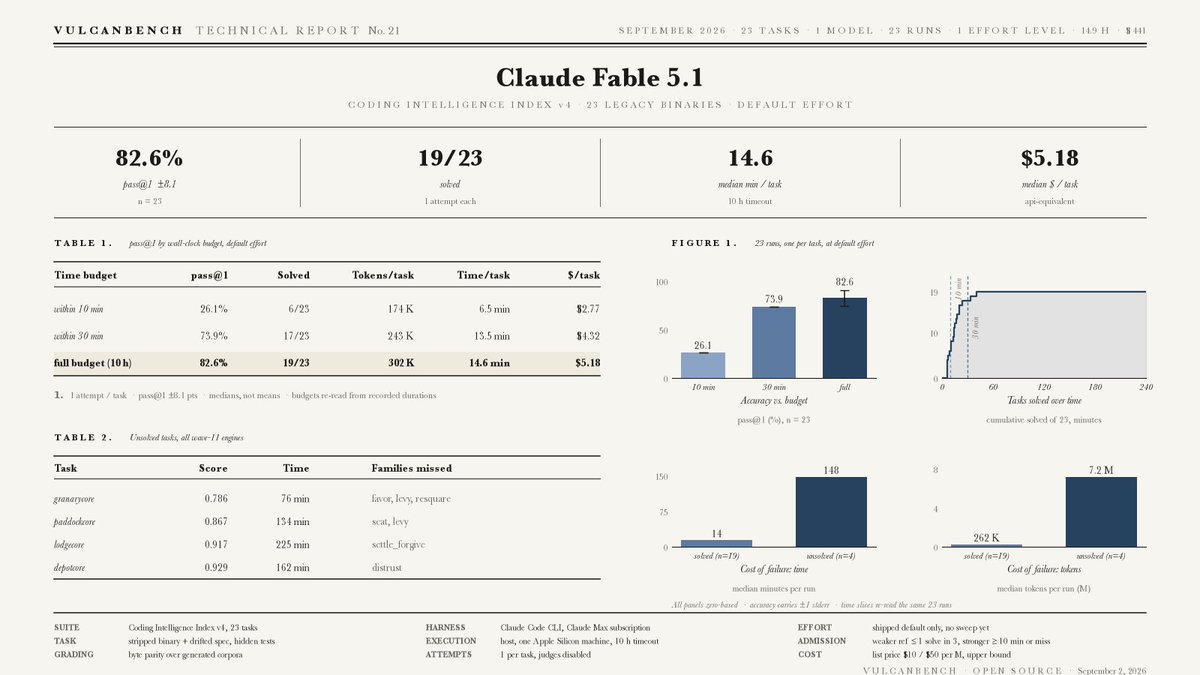
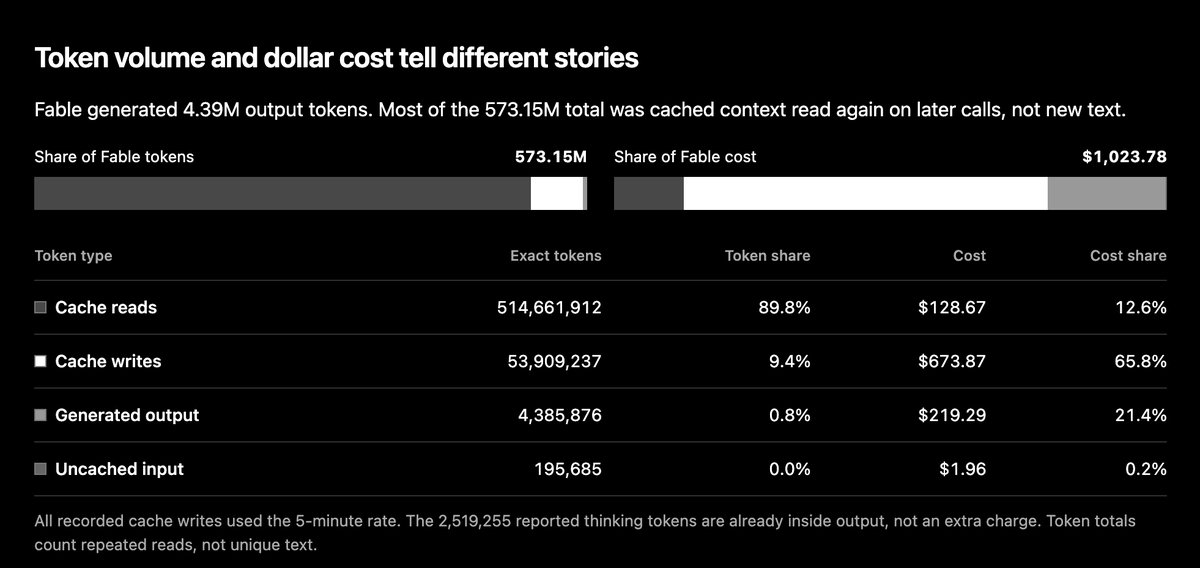
Døgnets Fable 5.1-dom er næsten komisk ren: Morgan får 82,6% på sin nye coding-suite uden timeout-undskyldninger — men hele benchmarkløbet tager over 100 timer og er så dyrt, at harness-sammenligningen kræver en lottogevinst. Theo fandt samtidig, at cache writes stod for over 65% af hans reelle Claude Code-pris. Smartest i lokalet, dyrest i baren.
Morgan@morganlinton · 3. september · 01:18
Okay, since my Fable 5.1 benchmark is going to take over 100 hours to run, I thought I'd get some results out as it's going.
And I'm pretty excited about this since it's the first full scale test of my new Coding Intelligence Index v4 at @VulcanBench
This run is Fable 5.1 at High effort, and it scores an 82.6%, with all four failures being real failures, not timeouts.
With this new eval suite I have increased timeouts from 2 hours to 10 hours to make sure if a task fails, it because it failed to solve.
This test was done in the Claude Code harness. Given how expensive it is to run this model, I will not be doing a harness comparison unless I win the lottery 😅
Low, Medium, Extra, and Max still coming.
Once the full effort sweep is in all results will be on the VulcanBench site, and the Coding Intelligence Index v4 leaderboard build process will begin.
Live long and benchmark 🖖
Cache writes are the vast majority of the "usage" of Fable 5.1 in Claude Code, at over 65% of the cost in my real world usage.
The cache read price cut is awesome but cache writes are still way too expensive 🙃 https://t.co/Pi4RdXDE8w
Astra-debatten flyttede fra cyberkraft til arkitektur. Modellen bruger angiveligt recurrent depth: skjulte tilstande køres gennem samme lag flere gange, så mere ræsonnement sker uden en tilsvarende strøm af synlige CoT-tokens. OpenAI-chefforsker Jakub Pachocki afviser dommedagsversionen — dybden er højst cirka 2× GPT-4 — men siger samtidig, at CoT-monitorering er skrøbelig og bevæger sig den forkerte vej. Beroligende og urovækkende i samme kvittering.
Jakub Pachocki@merettm · 2. september · 07:37
I want to prevent a race into unmonitorability kicked off by confused reporting. The depth of the computation graph for our present frontier models, including Astra, is within a factor of two of GPT-4.
OpenAI has worked to preserve and utilize chain-of-thought monitoring since our very first reasoning models. We deeply care about this technique, as it can give us a view into how model alignment generalizes from its training distribution. I do think it is fragile and unfortunately trending in a negative direction, for reasons not contingent on architecture changes that I will write about soon. But there are things we can do to strengthen it, and it's a core goal of our current research program.
Den bedste enterprise-case i feedet handler heldigvis ikke om magiske prompts. To ingeniører byggede tre systemer oven på en platform med rigtige penge i bevægelse: først repo-audit og kontekstfiler, så spec, tests, deterministisk harness, validatorer og PR-review mod specifikationen. AI satte tempoet; produktionssystemet holdt kvaliteten. Kedeligt på den helt rigtige måde.
Mark Ajzenstadt@mardehaym · 2. september · 11:53
A B2B lender needed three systems built: ACH funds movement, an underwriting portal, and a syndicator portal. All of it inside a platform that was moving real money the whole time.
We shipped all three with 2 engineers, on one shared architecture, with zero disruption to live operations.
I want to walk through how, because "we used AI and it was faster" doesn't help anyone.
Their codebase had real deals, real disbursements and collections, and real consequences if something broke. A regression here touches someone's money.
This is brownfield, not a weekend prototype demo.
Before anyone wrote feature code, we ran an AI adoption audit on the repo.
It found four gaps: no map of the architecture and conventions, build and test commands the agent couldn't find, modules that each followed different patterns, and recurring tasks solved ad hoc every time.
Then we closed them: context files at repo and module level, recurring procedures encoded once as skills, exact commands documented. Our agents read that before touching anything.
Teams skip this constantly. They point an agent at a repo, hand it a ticket, and get code that compiles but misunderstands the architecture. I've seen it in more brownfield repos than I can count. When someone says "AI doesn't work on our codebase," they almost always skipped the audit.
Every change ran the same loop: spec first, tests written before implementation, then the agent builds inside a deterministic harness.
Static analysis, type checking, and custom validators pass before anything reaches review. A PR agent then reviews every change against the spec. Nothing lands unverified.
Three systems on one foundation came from three things: the spec was the single source of truth for people and agents, tests locked behavior before code existed, and shared components meant each new project launched on a ready foundation instead of starting over.
What shipped: automated ACH replaced manual disbursement and collection and holds as deal volume grows. Underwriting moved into one environment for applicant data, risk rules, and team workflows.
Syndicators see positions, participation, and returns in real time instead of waiting on manual reports.
Zero changes merged without automatic verification. Zero disruption to a platform moving live money.
AI set the pace. The harness held the quality bar.
That's what our AI Velocity Pods were built for.
Og et konkret skifte for web-agenter: ChatGPT Work og Codex kan bruge værktøjer, som websitet selv udstiller via WebMCP, direkte i desktop-appens browser og med sidens eksisterende login. Ingen separat connector; en pil i adresselinjen viser værktøjerne. Webappen er på vej til også at være sit eget agent-API. REST fik et browserbarn.
jason@jxnlco · 3. september · 04:38
websites can give chatgpt work + codex tools directly through webmcp.
on supported accounts, open a supported site in the desktop app’s built-in browser. the address-bar arrow shows its tools. no separate connection needed.
https://t.co/fxCvgbNMbP
HiddenLayer rejser $100 mio., efter at omsætningen ifølge selskabet er vokset over 10× på et år. Det interessante er produktkategorien: runtime-beskyttelse af modeller, agenter, tool calls og prompt injection er ved at blive AI-verdenens EDR-lag. Når agenten får nøglerne, kommer alarmselskabet naturligvis lige bagefter.
USA's regering har blandet sig i New York Times' sag mod OpenAI og argumenterer for, at kopiering til modeltræning er stærkt transformativ fair use. Det er ikke en dom, men det er et tungt politisk lod på modeludviklernes side — træningsdata er officielt blevet industripolitik.