Lørdagens briefing

Dagens Vibes — 19. september 2026

Dagens feed handler mindre om større modeller end om bedre grænseflader: WebMCP gør et browser-benchmark trivielt, fire tools holder Pi på Pareto-fronten, og AGENTS.md bliver fælles valuta. Imens flytter en 27B-model ind på en fem år gammel GPU.

Fra X-feedet

WebMCP fjerner browseragentens klik-skat

Jev vælger handlingen, Mercury skriver argumenterne, og websitet udstiller de rigtige tools. Det gav 49/49 opgaver mod 25/49 med DOM-kontrol uden WebMCP — til 0,11 cent per opgave. Den interessante modelparameter er interfacet.

idan levin@0xidanlevin
We just ran Jev on our WebMCP benchmark. The result: basically broke the benchmark. Jev + Mercury 2.5 (a fast, low-cost LLM) using WebMCP solved 100% of the tasks at roughly 112× lower model cost than GPT-6 Astra using computer use with code execution. Compared to Astra using screenshot-based computer use, the model cost was 245× lower (!). We also compared Jev operating the browser with and without WebMCP. We used Browser Use’s open-source Ultrafast, with some improvements to the harness to make it more reliable across the benchmark. Jev’s browser-control accuracy on its own was not amazing - adding WebMCP nearly doubled the number of solved tasks, from 25/49 to 49/49, while reducing model cost by 18% (more on why below). The benchmark and methodology are fully open and reproducible. Full results: https://webmcp.com/benchmark A few words on how the Jev + WebMCP harness works and why this is exciting: Jev receives text as input and a set of discrete options it can choose from. With WebMCP, those options are the tools exposed by the website. At each step, Jev sees the task, the available tools and previous results, then picks what to do next. The limitation is that Jev can’t generate arbitrary text, which you need for tool arguments. For example, it can choose the search_products tool, but it can’t generate the search query itself. So we split the work: Jev picks the tool and Mercury 2.5 generates the arguments if needed. This works well because turns out most of the cognitive load in these tasks is around choosing the right action. The argument generation itself is relatively simple, so we can delegate to a small and very fast model. We used Mercury, which outputs 1,000+ tokens/sec and is very cheap. The result is a pretty simple combination: Jev for tool selection + Mercury for arguments + WebMCP for the interface. It ends up being very reliable, very fast, and very cheap. A few words about Ultrafast and why do we think it underperforms: Without WebMCP, Jev chooses from the page’s controls: which button to click, which field to fill, or which option to select. But choosing a valid button is different from choosing the right next step. The agent still has to navigate menus, understand forms, recover from errors and recognize when the task is actually complete. Our hypothesis is that WebMCP makes the decision space much simpler. Instead of figuring out a sequence of clicks through a website, Jev chooses explicit actions that directly advance the task. @typesafeai itself documents weaker accuracy on questions requiring multiple reasoning steps. WebMCP moves much of that complexity into the website’s tools, leaving Jev with clearer decisions and fewer opportunities to go wrong (in a sense WebMCP "compresses" a sequence of clicks into one tool call). Our modified Ultrafast setup solved 25/49 tasks - that is a result for our particular implementation and benchmark, not a universal limit on Jev or Browser Use. We are open to more harness optimization to get this result to perform better, feel free to directly contribute to the benchmark here: https://github.com/nekuda-ai/WindTunnel Browser-use ultrafast: https://github.com/browser-use/jev-ultrafast
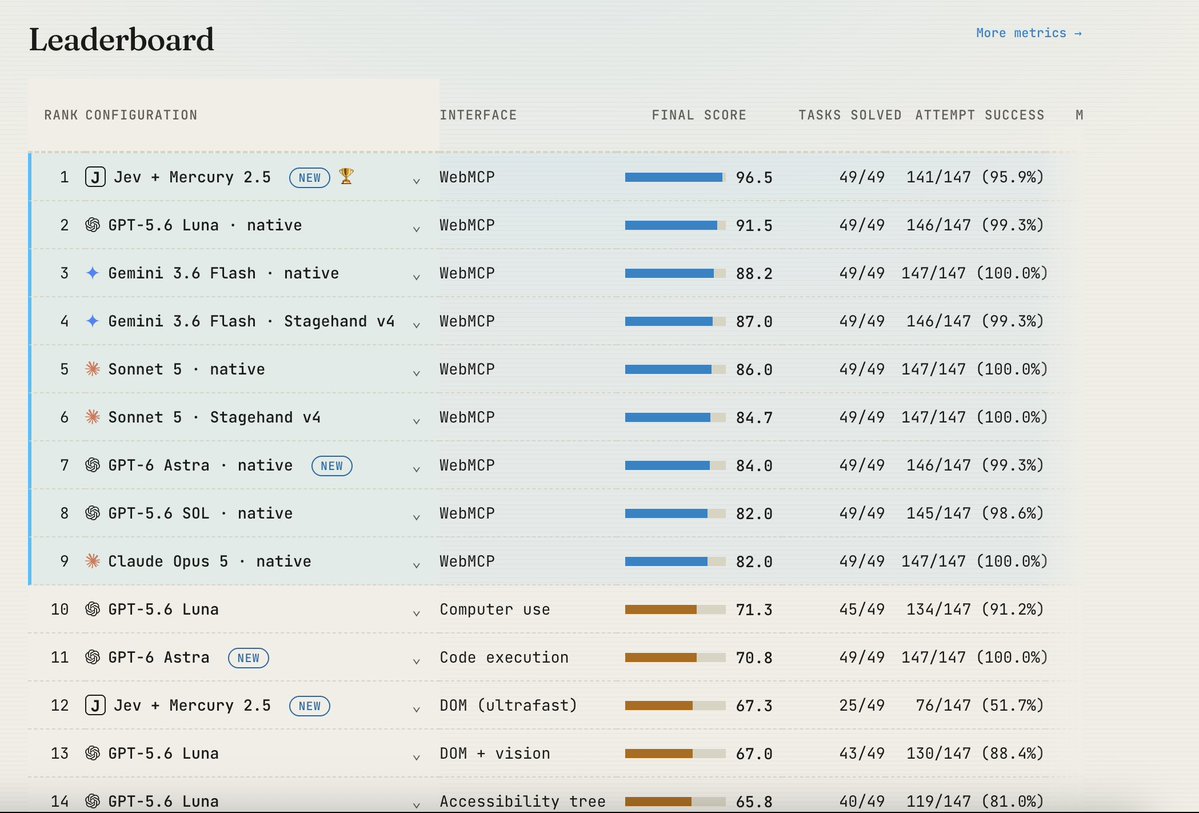
WindTunnel-resultater for Jev og WebMCP
♥ 1.563   ↻ 118   💬 64   🔖 1.656
https://x.com/0xidanlevin/status/2100937437325205568

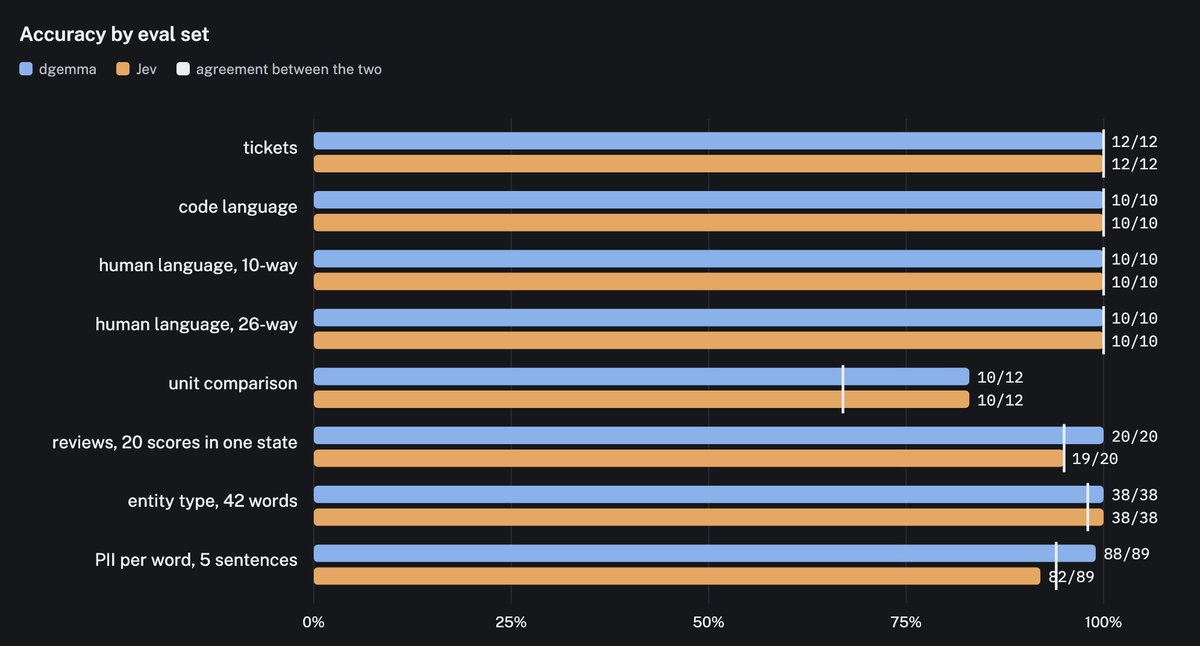
Den nødvendige modvægt til launch-hypen: Matt Mastraccis lokale DiffusionGemma-patch var omtrent lige så klog som Jev og hurtigere på hans DGX Spark. Det er ikke en ren hardware-sammenligning, men det er en reel hands-on test og et tegn på, at modelklassen hurtigt får konkurrence.

Matt Mastracci@mmastrac
I ran some real, live evals on Jev vs DiffusionGemma-as-Jev (my patch for vLLM!) DiffusionGemma comes out as the winner, I think. Headlines: Is Jev faster than DiffusionGemma? No ❌ (API vs DGX Spark) Is Jev smarter than DiffusionGemma? No ❌ (they're roughly tied!)
Jev sammenlignet med DiffusionGemma
♥ 771   ↻ 52   💬 42   🔖 585
https://x.com/mmastrac/status/2100626193943052784

Se alle 147 forsøg, priser og traces · Kør benchmarken selv

Fire tools er åbenbart et komplet køkken

HarnessTax testede 21 model–harness-par på SWE-bench Lite og Terminal-Bench. Korrektheden flyttede sig kun lidt, mens prisen kunne variere op til 5×; Pi ramte Pareto-fronten med bare read, write, edit og bash. Minimalisme har fået kvitteringer.

Pi@pidotdev
"Pi reaches the Pareto frontier on both benchmarks by providing just four tools: read, write, edit, and bash. To understand how harness design affects spending, we examine costs across completed attempts, recorded turn counts, and initial context." Sharing this analysis on the Harness Tax by @MelissaPan and others. https://harnesstax.github.io
HarnessTax-resultater
♥ 952   ↻ 60   💬 26   🔖 424
https://x.com/pidotdev/status/2100935860413673605

Læs studiet og metoden

AGENTS.md bliver et fælles stik

Claude Code 2.1.277 læser AGENTS.md, når CLAUDE.md mangler. Den lille detalje fjerner endnu en parallel instruktionsfil — og implementationen er selv bygget som en åben Claude Code-mod.

Thariq@trq212
We're adding support for AGENTS.md to Claude Code. Starting today in version 2.1.277, if there is no CLAUDE.md in a folder, Claude will check for and use AGENTS.md. You can toggle this behavior in /config.
♥ 23.857   ↻ 2.023   💬 1.588   🔖 4.187
https://x.com/trq212/status/2101009392611278961

Se AGENTS.md-modden

Den bedste agent-spec i dag er et nej til zombies

Trevins rejsetids-agent gør tre ting rigtigt: kalenderen er sandheden, menneskelige rettelser bliver til policy, og en lille ledger forhindrer slettede blokke i at genopstå. Det er præcis sådan en cron undgår at blive et hjemsøgt hus.

Trevin Chow@trevin
Prompt I've been working on for my @Muse, which should also work just as well with Instinct and Grok @bot. Goal is to protect travel time on my calendar. Fun fact: I tried to build this as a small app last year, but was blocked for over 6 months by Google's approval process, so I gave up. Fast-forward, the bots in our lives can do it! give this link to your bot https://share.trev.in/trevin/f/qMGOLo/travel-time-buddy.md Full prompt: ---- Job: Protect my calendar with travel buffers so I can physically get to meetings that aren’t at wherever I’m working that day. Horizon: Look 14 days ahead in my local timezone. Re-scan on a standing cadence (e.g. each weekday morning, plus when I tell you something changed). Don’t pretend you watch the calendar continuously. Before you start (ask once, then remember): My usual workplace address(es) — office, home office, or both. How you can tell office vs WFH (or ask me that day if you can’t). Which calendar(s) to protect, and whether travel blocks go on personal, work, or both. Default travel mode (car unless I say transit/walk/bike). Which events get buffers: Has a real place (street address or place you can reliably locate). That place is meaningfully different from my workplace for that day. Skip: video/phone-only with no place; already at my workplace that day; vague locations (“downtown”); all-day soft holds; flights/hotels unless I explicitly want airport buffers. Origin for each leg: Start from my workplace that day, or from the previous event’s location if I’m chaining in-person meetings. Evenings/weekends default to home if I’ve given you a home address. How to block: Use live travel time (Maps-class ETA) for the mode in force. Add a to buffer before and a from buffer after (ETA + a small pad, rounded to sensible calendar minutes). Title every buffer exactly: Travel time. Busy, no attendees. Put origin → destination, mode, ETA source, and managed-by: travel-buffer in the description only — not the title. If a buffer collides with another hard commitment, don’t silently overwrite — ask, or shorten and leave the calendar as the record of what you did. Ask when unsure (one clear question, then stop): ambiguous place, unknown office/WFH, unclear mode, or a buffer that would wreck the day. Do not fight me: If I delete, shorten, move, or retitle a travel block, that’s policy for that event. Remember it. Never recreate the same buffer unless the meeting time/place changed or I ask. Keep a small ledger of buffers you created and any I dismissed or edited. On re-scan: skip dismissed; only update when the underlying meeting moved or changed address. Stay quiet: Don’t narrate adds or changes in chat. The calendar is the evidence. Only message me when you need a decision. ---
♥ 22   ↻ 0   💬 1   🔖 29
https://x.com/trevin/status/2100985450248712547

Hent prompten som markdown

27B og 262K context på et 12 GB-kort — med en grim første test

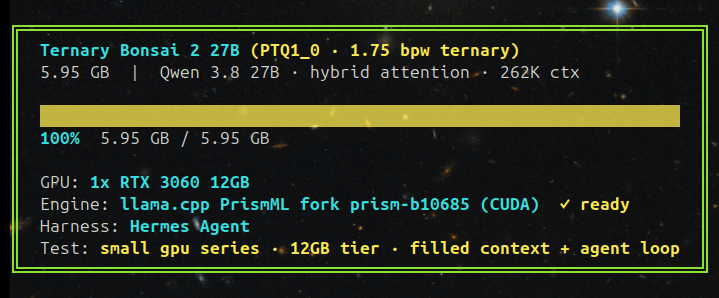
Bonsai 2’s ternary Qwen3.8-weights fylder 5,93 GB; Sudo fik hele 262K-vinduet resident på en RTX 3060 med 11,7 GB brugt. Pladsen er bevist. Kvaliteten fik straks en bule.

Sudo su@sudoingX
loaded. bonsai 2 27b is sitting on an rtx 3060 12gb right now, served through the prismml llama cpp fork with the full 262k context window resident, 11.7 of 12 gigs in use, hermes agent pointed at it. first receipt before a single benchmark: a 27b holds its entire native window on a 12gb card. now we find out what it does and how fast it runs. for anyone new here, bonsai 2 is not a new model. prismml took qwen 3.8 27b, a dense 27b that needs around 16gb at q4, and compressed the weights to ternary, three values per weight, 1.75 bits each, 5.95gb on disk, and their table says it keeps 98.2% of the full model on their suite. the 3060 is the number one desktop gpu on steam at 3.92% of every pc, a five year old card, so if a 27b runs as an agent here, it runs for more people than on any other card on earth. for anyone who followed the july run, bonsai 1 was the same idea on qwen 3.6 27b at 1 bit, 3.9gb, and it held a 30 minute agent loop on an 8gb 3060 ti. bonsai 2 is a bigger file on a better base, so the question moved from does it run to how much of the full model survived. tonight, in order: speed at empty context and at 64k filled, then a real build through hermes agent, the same spec the july run had to pass. receipts as they land, tool named on every number.
Bonsai 2 27B på en RTX 3060 med 12 GB
♥ 287   ↻ 14   💬 21   🔖 164
https://x.com/sudoingX/status/2100998897091100957

Kevins workflow med basal jq tog 10–20 ture mod to på den almindelige 27B. Ét stille datapunkt vælter ikke producentens benchmark, men det er præcis den uafhængige vibe check, som “98,2 procent bevaret kvalitet” havde brug for.

Kevin@kcosr
Taking this back, unfortunately. It really struggles with basic things. I have a workflow where I ask the agent to check something that requires using jq. 27B completes it in 2 turns. This one takes 10-20 tripping over syntax errors repeatedly.
♥ 0   ↻ 0   💬 0   🔖 0
https://x.com/kcosr/status/2101076127800557858

Modeldetaljer og producentens benchmarks · Den nødvendige llama.cpp-fork

Nyhedsbonus

Tre sikkerhedsforskere brugte Opus 5 til at gøre en kendt libheif-fejl til et stabilt exploit; derefter kædede de den med OpenAI’s SSO og beviste adgangen ved at få Codex til at åbne en PR i virksomhedens interne monorepo. Hele forløbet tog under 72 timer. Opus 4.8 sad fast på et stabilt exploit; 5’eren knækkede den del på timer.

TechCrunch · 18. september

Claude hjalp med at hacke OpenAI

Bug-bounty-forløbet gav 6.500 dollar; Hacktrons tekniske rapport viser både exploit-kæden og hvor meget sjælden ekspertise modellerne komprimerer.

Læs Hacktrons tekniske gennemgang

Anthropics første indlejrede, “uafhængige” evaluator bliver Faculty under Accenture. Parterne forventer hver at investere mindst én milliard dollar over fem år; evaluatorerne får medarbejderlignende adgang, mens standarder for adgang, rapportering og finansiering stadig mangler. Revision møder konsulentkonglomerat. Naturligvis.

TechCrunch · 18. september

Accenture flytter ind i Anthropic som evaluator

Aftalen er ikke-eksklusiv, og Anthropic siger, at METR og andre nonprofit-evaluatorer følger senere.

Læs Anthropics annoncering

Californien vil omsætte ugens sikkerhedspanik til mekanik: et ekspertpanel får to måneder til at foreslå onsite-evaluatorer, verificerede nødstop og obligatorisk rapportering af loss-of-control-hændelser. Foreløbig er det en bestilling på regler, ikke selve kill-switchen.

The Verge · 18. september

Newsom bestiller en plan for AI-kill-switches

Ordren accelererer Californiens nye auditregler og vil gøre uafhængig verifikation til en fast del af frontier-labs.

Læs den signerede executive order