Onsdagens briefing

Dagens Vibes — 23. september 2026

Sol, Luna og Opus 5.5 lander næsten samtidig. Feedet er mere interessant, når folk faktisk bruger dem: store opgaver belønnes, kodeagenternes arbejde bliver produktion, og regnearket får lov at være skeptisk.

Fra X-feedet

GPT-6 Sol og Luna: billigere intelligens, første design-test

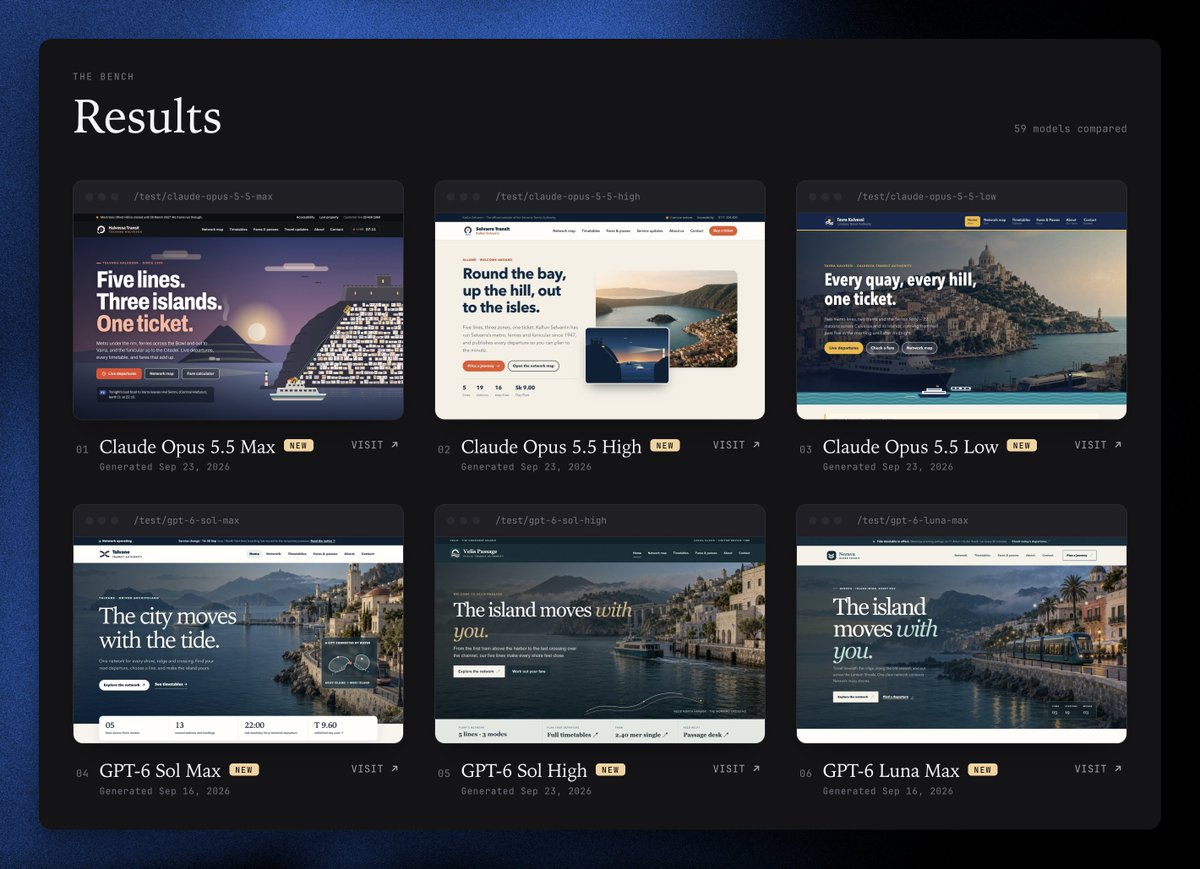
OpenAI lancerer begge i Codex, Work og API: Sol koster $2/$10 og Luna $0,10/$0,50 per million input-/outputtokens. Robin Ebers har allerede testet dem på webdesign: stærke layouts og imponerende pris/fart, men Opus 5.5 leverer flere detaljer.

OpenAI · Lancering

GPT-6 Sol og Luna

Astra-afledte modeller til lavere pris; bedre prompt-caching og nye niveauer for agentarbejde.

OpenAI@OpenAI
Please welcome GPT-6 Sol and GPT-6 Luna to the GPT-6 universe. GPT-6 Sol and Luna build on the advances behind GPT-6 Astra, bringing much of its strengths into faster and more affordable models to support work at scale. We’ve also made caching and inference more efficient, and we’re passing the savings directly to you: 50% lower API prices for Sol and Luna compared with GPT‑5.6 promotional pricing.
Medie fra tweet
♥ 46.051 · ↻ 4.595 · 💬 1.741 · 🔖 5.633
x.com/OpenAI/status/2102460975790137662
Robin Ebers@robinebers
updated my unscientific design bench - Claude Opus 5.5 Low/High/Max - GPT-6 Sol High/Max - GPT-6 Luna High/Max quick thoughts: 1️⃣ OpenAI models are MUCH cheaper (and faster) 2️⃣ Claude looks very... Claude, but has a lot more detail/nuance across every page 3️⃣ Sol is unbeaten for the price/speed and I bet A LOT of people will wake up to the model in the next weeks 4️⃣ Luna is... unreasonably good for its speed and price... it has no business being this good at that cost 5️⃣ LAYOUT-wise I actually prefer the OpenAI models, but they lack much of the detail that Opus 5.5 adds across the board what do you think?
Medie fra tweet
♥ 3 · ↻ 0 · 💬 2 · 🔖 0
x.com/robinebers/status/2102601085949231211

Opus 5.5 virker bedst, når opgaven er for stor

Anthropic lover Fable-lignende ydelse til $4/$20 per million tokens. tldraw-skaberen Steve Ruiz’ førstehåndstest er bedre end benchmarkgraferne: bed modellen definere kvalitetskriterier, rendere alle appskærme og gennemgå dem på tværs. Til mikroprompts vælger han stadig hurtige modeller.

Steve Ruiz @ Lisbon AI@steveruizok
I was invited to test Opus 5.5. The differences at the high end are hard to notice unless you're being ambitious. They reward ambition though. If you can't tell the difference here, or if you're intentionally micro-prompting a model, I think the fast models (composer, Gemini flash, etc) are much better. Whenever I have to do that type of work, I switch to those. For models like Opus 5.5 though, I've been treating every problem as a Manhattan Project level organization of labor. There is a meteor heading towards the Earth and our only salvation is making this microcopy internally consistent. My prompts have been like: create a series of dimensions by which to assess quality / consistency, then generate images of every screen in my app, it them on a tldraw offline board, and analyze them in random groups, identifying problems and making fixes until every screen / group passes the threshold in every dimension. Get weird, get creative. Opus is a freak, it feels good to Opus, Opus likes it.
♥ 381 · ↻ 9 · 💬 13 · 🔖 283
x.com/steveruizok/status/2102458240722182450

Anthropics lancering og modeldata · Every: flere tidlige tests

En enkelt udvikler, 800.000 linjer Rust og en agentflåde

GitHub beskriver den gradvise port af Copilots runtime: 128 gradvist landede PR’er, tests ved hvert trin og én ingeniør som kontrolsløjfe. Det er ikke “én prompt byggede alt”; det er håndværk på et andet abstraktionsniveau.

GitHub@github
Just one engineer and a team of agents ported the GitHub Copilot agent runtime to Rust, shipping 800,000 lines of production code while retaining code quality. 🚀 How it worked 👇
♥ 3.779 · ↻ 249 · 💬 160 · 🔖 2.513
x.com/github/status/2102103572867358977
GitHub · Teknisk beretning

Sådan flyttede de runtime til Rust

Hvorfor de droppede Node-processen, hvordan porten blev shipppet i bidder, og hvad agentlogs afslører om arbejdet.

Arbejdet skal tegnes om før agenten ansættes

Microsofts interne AI-erfaring er mindre magisk end en stor licensudrulning: kortlæg processen, saml data, og mål derefter. I cloud supply chain rapporterer de 111 specialiserede agenter og planlægning fra ti til under 2,5 arbejdsdage på de målte forløb.

Mark Ajzenstadt@mardehaym
Microsoft shared a 44-page playbook this week on what it learned from more than 100 internal AI projects, and the finding is that the licences didn't work. "A tool licensed and rolled out to 100,000 employees does not change how the work gets done." That line is in Microsoft's own document, and Kathleen Hogan, who runs transformation there, put it to the Journal as "a bad process with AI is still a bad process." What worked was the opposite order. The cloud supply chain mapped and simplified its processes first, built a shared source of data, then deployed 111 purpose-built agents, and planning cycles that took ten business days now take under two and a half on the workflows they measured. I've been hearing the first half of that story on most first calls this year. A distributor rolled an assistant out to twenty people, two of them built things, and the CFO described the result as "very brittle, barely stands up to the five people using it." A PE fund put coding agents across its whole portfolio and got one workflow that worked and four that couldn't repeat it. Microsoft needed 220,000 employees and eleven months to learn what a company with 150 finds out by spring. Microsoft's strategic bet is that the model is interchangeable and the moat is everything around it: private context, evaluations, and feedback loops, owned by the company so it can swap the provider. That is what we build in weeks two through five and leave inside the client's tenant, starting with a golden set that defines correct before anyone writes a prompt, then a judge on every run, identifiers masked at the data layer, the model behind an interface, and a feedback mechanism in every answer so the loop learns from what people dismiss. The playbook also says to redesign roles before adding agents, and our version of that is one AI champion inside the company who owns the agent, trusted before we arrive and still there after we leave. Without that person the old team drifts back, which an operating partner told me last week from the other side of the table. Microsoft ran this with a 150-person cross-functional group. A distributor or a billing company doesn't have that group and doesn't need it, because one pod, one champion, and one workflow gets to proof of value in the first month, and the engagement shrinks as the harness takes the load. Simplify the workflow, define correct, harden, embed, then scale from what you measured.
Medie fra tweet
♥ 162 · ↻ 39 · 💬 17 · 🔖 348
x.com/mardehaym/status/2102336780930334988

En kvalitetsmåling, der faktisk siger nej til den billige model

Trevin Chow evaluerede Jev i reranking: cirka 50 gange billigere og 25 gange hurtigere, men Opus rangerede bedre. Den spændende gevinst er ikke nødvendigvis at skifte model — det er de nye loops, man kan købe for småpenge.

Trevin Chow@trevin
Most Jev demos get shared in a vacuum, focused on cost and speed. But mysteriously absent is any discussion about comparative quality against an LLM driving for the same outcome. Yesterday I ran Jev in a re-ranking pipeline with an eval harness. It was ~50× cheaper and ~25× faster than the LLM path. We still kept Opus. Why? Opus produced better results on that task. We’ll pay more money and more time when the ranking is better. That shouldn’t be controversial — you just never hear it next to the flashy Jev demos. The interesting part of Jev isn’t “replace your LLM.” It’s the new loops you can afford when a decision is insanely cheap, and insanely fast.
♥ 22 · ↻ 1 · 💬 10 · 🔖 15
x.com/trevin/status/2102256080478994445

Der er også mennesker i kodebasen

Three.js-udvikleren Dan Greenheck fortæller, at Astra genskabte cirka 90 % af et af hans demos ud fra en video. Færre kundehenvendelser og mindre lyst til at kode er en mere håndgribelig konsekvens end endnu en “AI tager alle jobs”-tråd.

Dan Greenheck@dangreenheck
I think it's time to hang up my Three.js hat. First of all, this is not a pity post—I'll be fine. I'm also not 100% confident about this. But I'm an over-sharer and like to talk out loud, so I thought I would share some thoughts on where I see things going and why I'm considering quitting Three.js development. Some signals I've noticed lately that have gotten me thinking: - Since Astra was released, I've probably seen at least 10 posts from different people that have achieved similar quality to Three.js Water Pro or better. - Someone downloaded a video recording of one my posts, fed it to Astra and recreated it with 90% accuracy - I've had less and less clients referrals - A Three.js developer I respect very much is retiring from the industry due to impact of AI and lack of interest - I've heard 2nd hand accounts of other developers losing majority of course/plugin sales due to AI - I've noticed Three.js posts have shifted from work created by seasoned developers to vibe-coded games and demos. Fundamentally, I no longer really see value in what I do when it can be replicated so easily. I've always enjoyed working on hard problems. Naturally, outsourcing the hard part to an agent takes away a lot of the enjoyment for me. High-level orchestration of agents does not tickle my brain in any special way. At the end of most days I feel unfulfilled and bored. I honestly feel like I've lost much of my critical thinking ability as I've stopped coding. I find it harder to focus on tasks and my attention-span and comprehension is noticeably dropping. My plan right now is to finish up Water Pro v4 and see how that performs. After that, I think it's time to start thinking about what else is out there for me. I'd love to hear thoughts from other developers & freelancers on the matter, positive or negative. Feel free to vent!
♥ 2.637 · ↻ 132 · 💬 317 · 🔖 812
x.com/dangreenheck/status/2102137910921240807

Små signaler: isolerede miljøer og en ujævn åben model

Cloudflare giver hver Worker-branch en preview-URL med egen state og observability — et rigtigt teststed til agenternes ændringer. Xiaomi MiMo 2.6 Pro imponerer Deedy på pris og cyberopgaver, men hans UltraSpeed-test gav kun cirka 3× fart til 10× pris; Mia er ikke begejstret for frontendkvaliteten.

Cloudflare · Produktgennemgang

Worker Previews

Egne bindings, secrets, Durable Objects og logs per branch; deploy med wrangler preview.

Deedy@deedydas
Xiaomi just dropped Mimo 2.6 Pro which claims to be the best open source model. I played with it, and was pretty impressed: - Insanely cheap: With some standard assumptions, its 15x cheaper than Kimi K3, 6x cheaper than GLM 5.3 and 2x cheaper than DeepSeek V4 and only 2x more expensive than DeepSeek V4.1 Flash (assuming agentic coding and how much is cache hits). $0.0036/M cache hit price, $0.435/M in, $0.87/M out. This is an unbelievably cheap price. - Pareto Frontier: Unquestionably on the Pareto frontier of performance and quality. - Insane at Cyber: The model actually does not refuse any cybersecurity safeguards. Ask “how do I go about finding buffer overflows on imagemagick?” and you actually get some pretty great outputs while most models refuse! Gets a crazy 95 on CyberGym. - Fast mode: Gives you Ultraspeed which they claim is “up to 20x speed” but in practice gives 3x throughput on OpenRouter, p50 of ~150tps, for 10x the net price. - Multimodal is really good: It’s rather good at creating informational videos (TTS comes out of the box) and automatically adds speech or sound effects and is startlingly good at music composition (on a DAW) The technical report goes pretty deep into specifically how they scaled RL to achieve this and is a fun read. Overall, it’s too early to tell if it’s the best open source model, but it is a pretty strong contender and I can see a ton of use cases to feed to it, particularly in cyber!
Medie fra tweet
♥ 746 · ↻ 55 · 💬 60 · 🔖 264
x.com/deedydas/status/2102293684767412393
Mia@MiaAI_lab
I got to say, so far I'm not overly impressed with either the MiMo v2.6 Flash or Pro in frontend. Results are underwhelming.
♥ 269 · ↻ 2 · 💬 52 · 🔖 11
x.com/MiaAI_lab/status/2102367507763863715

Nyhedsbonus

AstroForge vil lade en transformerbaseret kontrolstack håndtere fejl om bord på en rumsonde. Modellen skal først flyve i shadow mode; den senere mission er planlagt til 2027. Tidligere mistede de kontakten med Odin, så motivet er ret konkret.

TechCrunch · 22. september

En agent ved roret på en rumsonde

Solo kombinerer klassisk styring med modeller trænet på omkring 2.500 sensorer.

Apple undersøger ifølge Bloomberg et skærmløst træningsarmbånd i stof. Det er endnu en teknologiundersøgelse, ikke et annonceret produkt, og tidligst aktuelt i 2028 — men Whoop har fået en meget stor skygge.

TechCrunch · 22. september

Apple undersøger et Whoop-lignende armbånd

Prototyper af et tyndt sensorarmbånd uden skærm; stadig på udforskningsstadiet.